
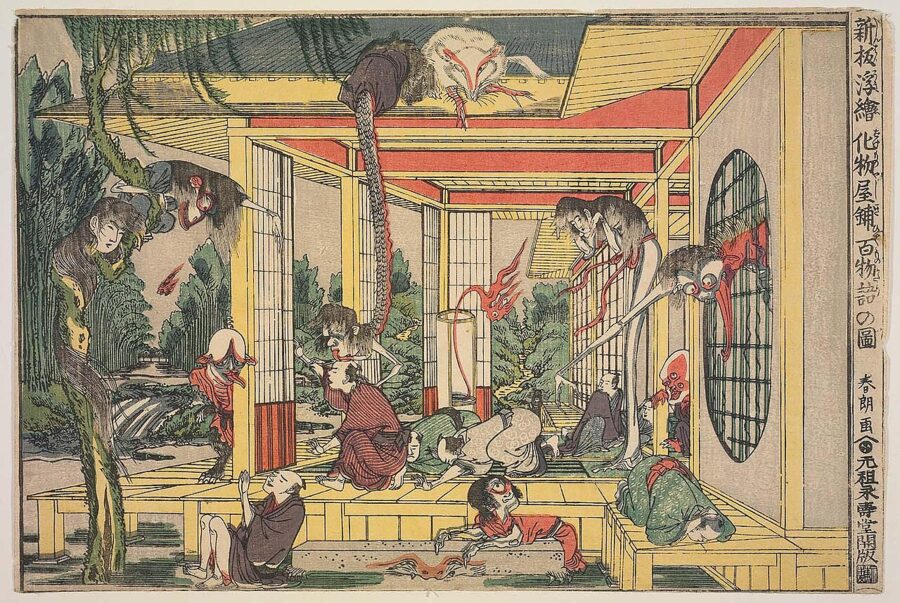
Light a hundred wicks in a lamp covered with blue paper, hide every sword in the room, and start talking. Each time someone finishes a ghost story, one wick goes out. That is how an Edo-period account from 1802 describes 百物語 (hyakumonogatari, “a hundred stories”), and it ends with a warning: when the last light dies, something comes.
Those stories are 怪談 (kaidan), and a handful are known by nearly everyone in Japan: Oiwa with her ruined face, Okiku counting plates at the bottom of a well, the woman with the peony lantern who walks on wooden clogs. They grew up on the kabuki stage and in storytellers’ halls, and an Irish-Greek writer living in Japan gathered a set of them into English in 1904.
You can still visit the places they are set: a shrine on a back street in Tokyo, a well inside Himeji Castle, a small hall on the strait at Shimonoseki. You also need the vocabulary, because a Japanese ghost is described with words that have no neat English match. I would learn yūrei and urameshiya before any of the plots.
目次 Contents
Kaidan and the Edo summer
怪談 (kaidan) joins 怪 (kai, strange or uncanny) and 談 (dan, talk). The word covers any tale of the uncanny, but in practice it means a ghost story, and above all one from the Edo period (1603 to 1868), when printed collections and stage plays turned local rumors into national hits.
The hyakumonogatari game came first as a pastime among samurai, a test of nerve according to one theory, and by the late 1600s it was a parlor game for anyone. Publishers sold the stories in collections such as Shokoku Hyakumonogatari (1677). Not every session ended in horror: in some folk versions the hundredth story brings gold coins falling from the ceiling.
Why ghost stories belong to summer
In English, ghost stories belong to Halloween and Christmas Eve. In Japan they belong to the hot months, for two reasons. The first is お盆 (Obon), the mid-summer festival when the spirits of the dead are welcomed home; the dead are already on everyone’s mind. You can read how families keep it in the guide to Japanese culture.
The second reason is the theater. In the Edo period the star actors took a break in the hottest weeks, and theaters filled the gap with 夏狂言 (natsu kyōgen), summer plays led by younger actors. Ghost plays became a summer staple, and a good scare doubled as air conditioning. The word for that relief is 納涼 (nōryō), “enjoying the cool,” and you still see it on summer festival posters.
Yūrei: what a Japanese ghost looks like
幽霊 (yūrei) is built from 幽 (yū, faint or dim) and 霊 (rei, spirit). A yūrei is the spirit of a dead person that has not moved on, usually because of love, jealousy or a wrong that was never paid for. It comes back for someone in particular.
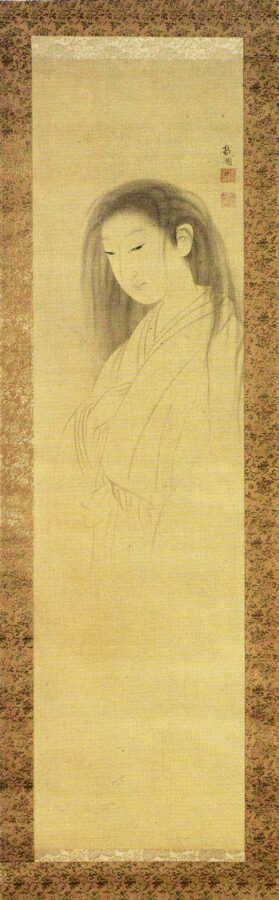
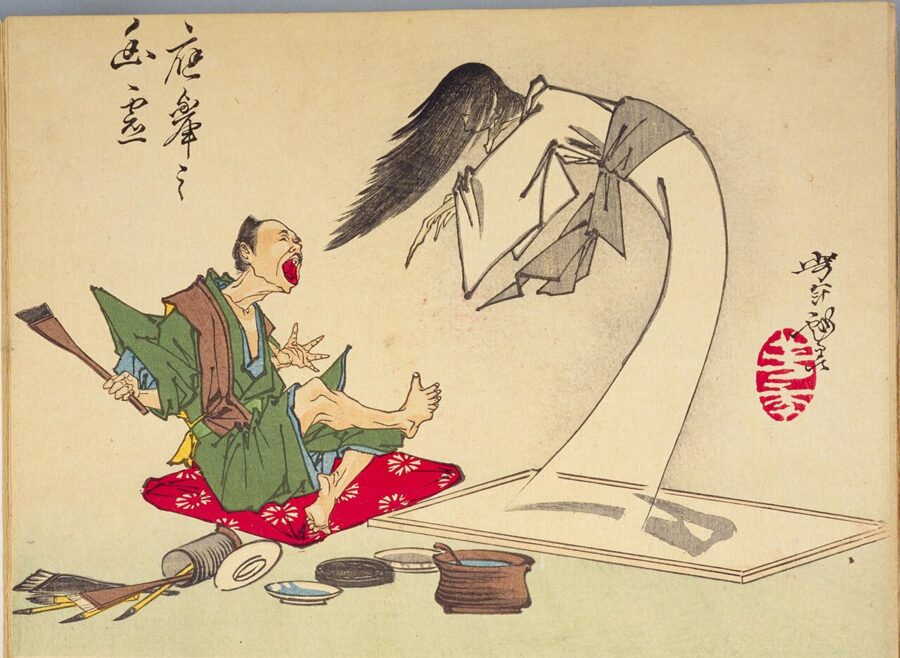
Early Japanese ghosts looked like they did in life. By the Edo period they had a uniform, borrowed from how bodies were dressed for the coffin:
- a white burial kimono, 白装束 (shiroshōzoku)
- a white triangle of cloth or paper on the forehead, 天冠 (tenkan), also called 額烏帽子 (nukaeboshi)
- long black hair worn loose and tangled
- hands hanging limp from bent wrists, held in front of the chest
- no feet: the body thins out below the waist
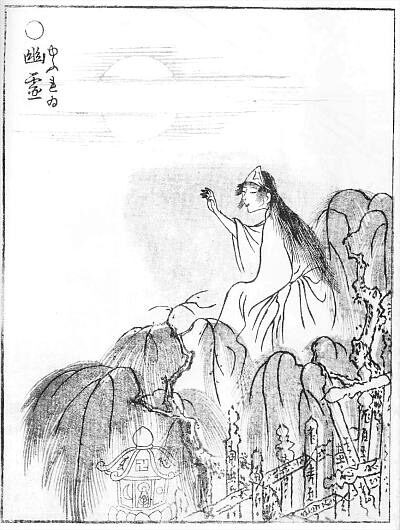
The painter Maruyama Ōkyo (1733 to 1795) usually gets the credit for the feetless ghost, but a book illustration printed in Kyoto in 1673, sixty years before he was born, already shows one. What Ōkyo did was make the ghost beautiful. Only a few of the many ghost paintings signed with his name are accepted as his. One, often called The Ghost of Oyuki, is on long-term loan to the Berkeley Art Museum in California.
Yūrei, yōkai and obake
A learner meets three words that all get translated “ghost,” and they are not the same thing. 妖怪 (yōkai) are supernatural creatures that were never human: the kappa in the river, the long-nosed tengu on the mountain. お化け (obake) and 化け物 (bakemono) come from 化ける (bakeru, to change form), so they are things that transform to frighten you, such as foxes in disguise or a paper umbrella with one eye.
The folklorist Yanagita Kunio drew the line with a timetable. Obake haunt a place and appear at dusk to whoever walks past. Yūrei go after one person, wherever that person is, and they come in the dead of night. In everyday speech the lines blur: a child will call any ghost an obake, and an お化け屋敷 (obake yashiki) is a haunted house at a funfair.
The words a learner meets
Here is the core vocabulary, kana first.
| Word | Reading | Romaji | Meaning |
|---|---|---|---|
| 怪談 | かいだん | kaidan | Ghost story, tale of the uncanny |
| 幽霊 | ゆうれい | yūrei | Ghost of a dead person |
| お化け | おばけ | obake | Ghost or monster, the everyday word |
| 妖怪 | ようかい | yōkai | Supernatural creature |
| 恨めしや | うらめしや | urameshiya | “How I resent you”: the ghost’s stock line |
| 祟り | たたり | tatari | A curse or punishment sent by a spirit or god |
| 怨霊 | おんりょう | onryō | Vengeful spirit |
| 人魂 | ひとだま | hitodama | Ghost-fire, a floating ball of flame |
| 丑三つ時 | うしみつどき | ushimitsu-doki | The dead of night, about 2:00 to 2:30 a.m. |
| 肝試し | きもだめし | kimodameshi | A test of courage, usually a night walk |
| 成仏 | じょうぶつ | jōbutsu | To find peace and move on (of the dead) |
うらめしや comes from the adjective 恨めしい (urameshii, resentful, bitter), with the old exclamation や on the end. Stage ghosts moan it with their hands hanging limp, and every Japanese child knows the pose. 祟り is heavier: it is what happens to you after the ghost has said it.
Notice the verb in the second example: ghosts simply 出る (deru, come out), the same verb as leaving a room.
| Japanese | Romaji | English | Level |
|---|---|---|---|
| 夏といえば怪談だね。 | Natsu to ieba kaidan da ne. | Summer means ghost stories, right? | Casual |
| この井戸には幽霊が出るそうです。 | Kono ido ni wa yūrei ga deru sō desu. | They say a ghost comes out of this well. | Polite |
| お化けなんて怖くないよ。 | Obake nante kowakunai yo. | I’m not scared of ghosts. | Casual |
| 背筋がぞっとしました。 | Sesuji ga zotto shimashita. | A chill ran down my spine. | Polite |
| 一枚、二枚、三枚…… | Ichimai, nimai, sanmai… | One plate, two plates, three… | Okiku’s count |
That last line uses 枚 (mai), the counter for flat things like plates, tickets and sheets of paper. Okiku is the most frightening counter lesson you will ever get. And when you talk about these ghosts in Japanese, they get a name ending like anyone else: お岩さん (Oiwa-san), お菊さん (Okiku-san), even the school-toilet ghost 花子さん (Hanako-san). The Japanese suffixes guide explains why -san fits a ghost too.
The great tales, retold
Japanese lists of the 三大怪談 (sandai kaidan), the three great ghost stories, name Yotsuya Kaidan, Sarayashiki and Botan Dōrō. To those I add two from Lafcadio Hearn’s book, because they are the ones English readers meet first.
Yotsuya Kaidan: Oiwa
Tsuruya Nanboku IV wrote Tōkaidō Yotsuya Kaidan, and it opened at the Nakamura-za theater in Edo in 1825. On its first run it was played across two days, cut into the middle of the famous revenge play Chūshingura.
Tamiya Iemon is a masterless samurai who has already killed Oiwa’s father. A wealthy neighbor wants Iemon for his granddaughter and sends Oiwa a “medicine” that is really poison. It ruins half of her face. In the scene everyone remembers, she combs her hair before a mirror, it comes out in handfuls, and she dies on a sword blade cursing her husband.
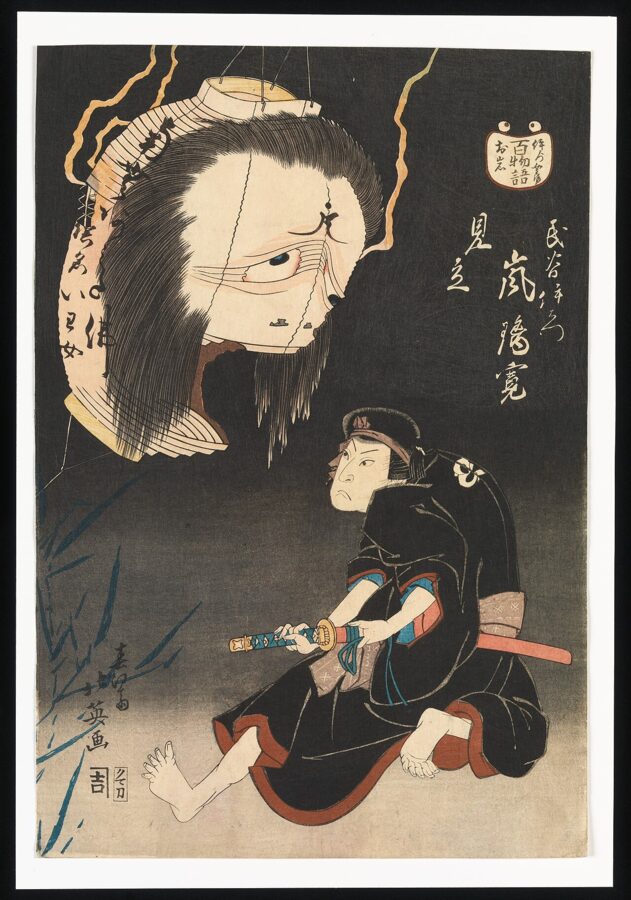
Iemon has her body nailed to one side of a wooden door and a murdered servant to the other, and sends it down the river. Later, fishing at a canal, he pulls the door in and flips it: Oiwa on one side, the servant on the other, both still staring. Her ghost then comes for everyone around him, in lanterns, in his new bride’s face, and in a swarm of rats, until he is cut down.
The play was fiction built on a local legend, but the Tamiya family was real and lived in Yotsuya. Their own records remember Oiwa as a faithful wife. The play is often called Japan’s most famous ghost story, and I think it is the most frightening, because the ghost is the only person in it who did nothing wrong.
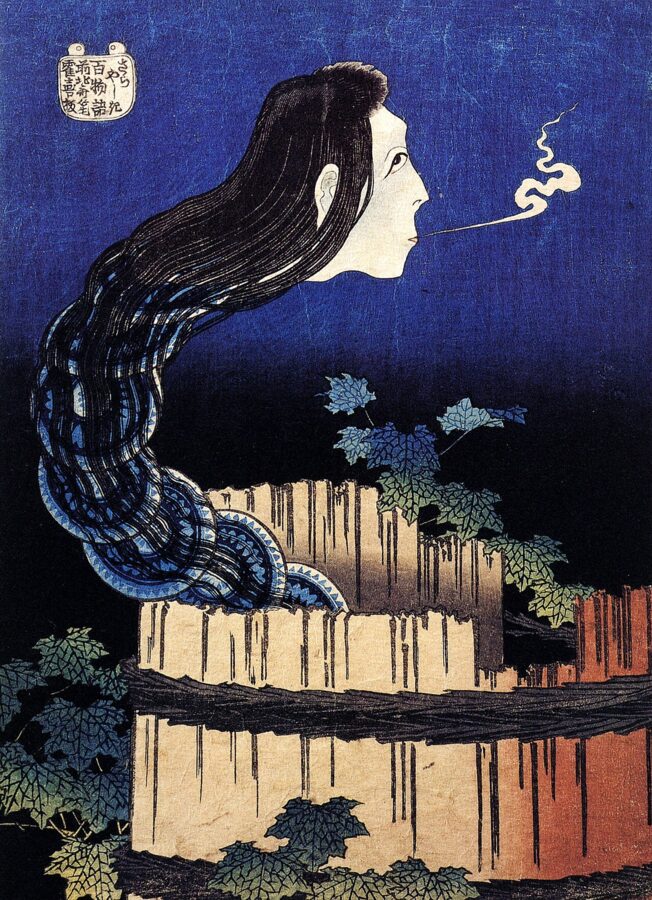
Sarayashiki: Okiku and the plates
皿屋敷 (Sarayashiki) means “the plate mansion,” and there are two main versions. In the Edo telling, set in the Banchō district, a maid named Okiku breaks one plate from a treasured set of ten, and she dies for it in the well. In the Himeji telling, Okiku is a servant at the castle who is framed with a missing plate and thrown down the well there. A puppet play, Banshū Sarayashiki, put the Himeji version on stage in Osaka in 1741.
Either way the haunting is the same. Every night a voice rises from the well counting plates, ichimai, nimai, up to nine, and then lets out a wail for the plate that is missing. In one ending a priest shouts “ten!” at the right moment, and the ghost finally rests.
Okamoto Kidō rewrote the Edo story in 1916 as Banchō Sarayashiki, a tragedy with no ghost in it at all. His Okiku breaks the plate on purpose to test whether her master truly loves her, and he kills her for doubting him.
Botan Dōrō: the peony lantern
This one began in China, in a Ming-dynasty tale of a peony lantern, and came into Japanese in Asai Ryōi’s collection Otogi Bōko (1666). The version Japan knows best is by the great rakugo storyteller San’yūtei Enchō, who built it into a long serial in the 1860s. A shorthand transcript was published in 1884, and kabuki staged it at the Kabuki-za in 1892.
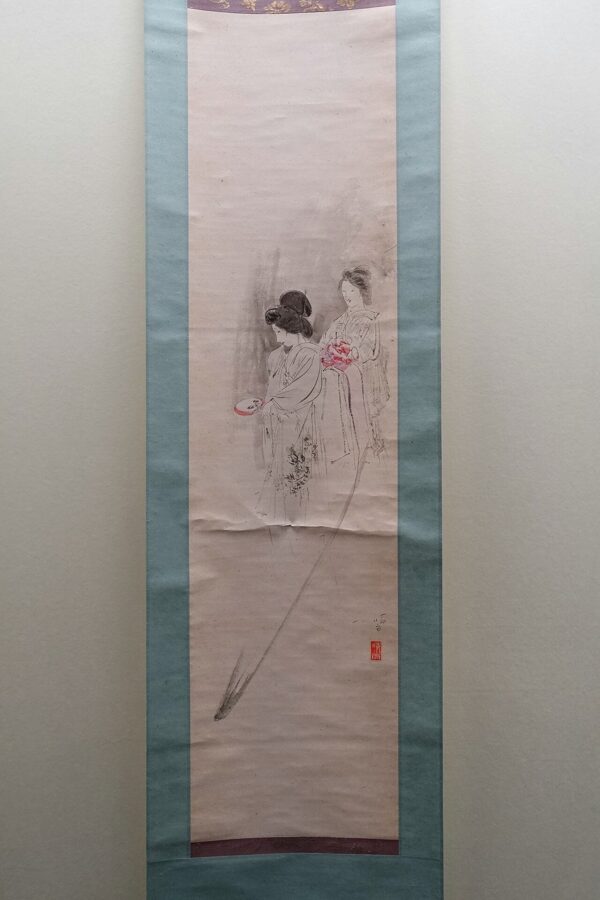
Otsuyu, a samurai’s daughter, falls for a young man, Hagiwara Shinzaburō, and dies of longing. During Obon she comes to his house with her maid and a peony lantern, and she keeps coming. A neighbor peeks in and sees Shinzaburō in the arms of a skeleton. A priest gives him paper charms for every door, but his servant takes a bribe from the ghosts and pulls one down, and Shinzaburō is found dead.
Otsuyu breaks the rules: she has feet. Japanese retellings make a point of the sound of her wooden clogs on the road, カランコロン (karan koron), still the sound word for geta.
Yuki-onna: the snow woman
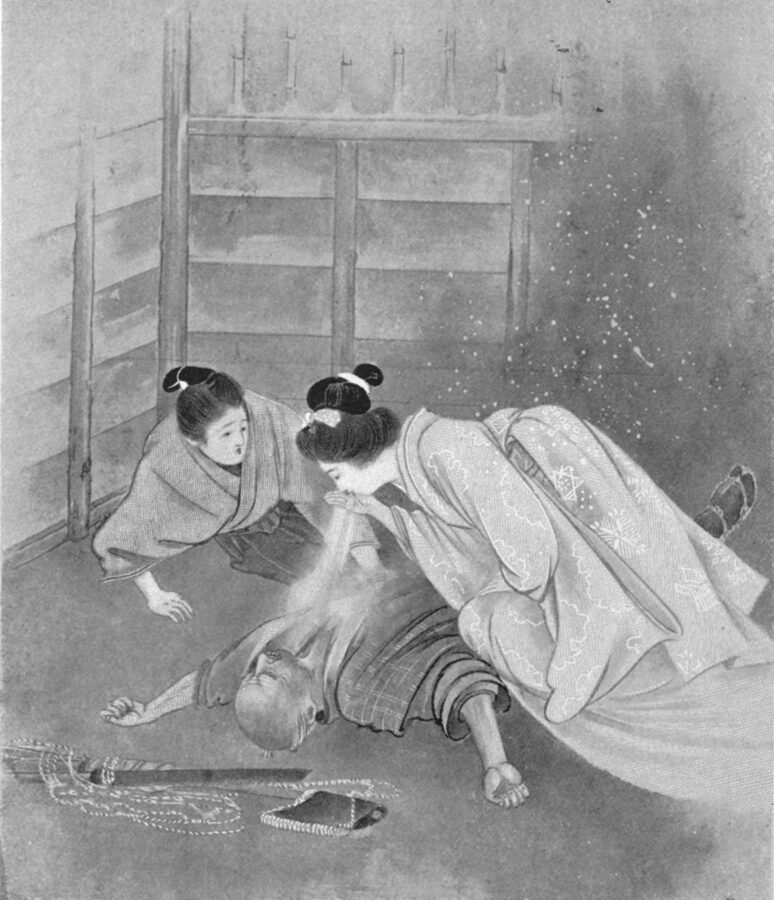
雪女 (yuki-onna) is older than any one story; she appears in a book from 1685. The plot most people know is Hearn’s: two woodcutters, old Mosaku and young Minokichi, shelter from a blizzard in a ferryman’s hut, and a woman in white breathes on Mosaku until he freezes. She spares Minokichi because he is young and handsome, on one condition: he must never tell anyone.
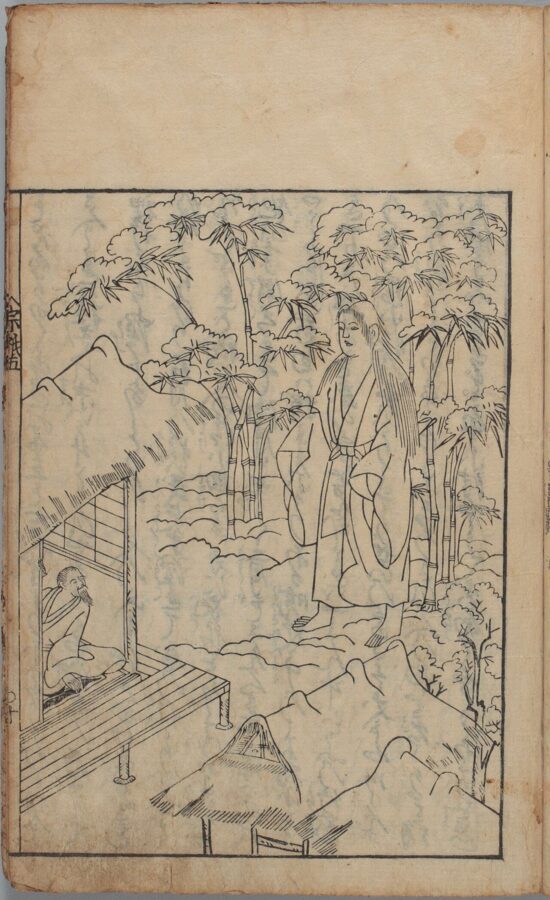

Years later he marries a pale, lovely woman called Oyuki, and they have ten children. One winter night he tells her about the woman in the snow. She is that woman. She spares him once more, for the children’s sake, and melts away through the smoke hole in the roof.
Hearn wrote that a farmer from Chōfu village in western Tokyo told him the tale. Scholars still argue over how much of the plot is Hearn’s own, since no matching version older than his has turned up.
Mimi-nashi Hōichi: Hoichi the earless
Hōichi is a blind player of the biwa, a Japanese lute, living at Amida-ji temple in Shimonoseki. His speciality is the Battle of Dan-no-ura (1185), where the Heike clan was destroyed at sea and the child emperor Antoku drowned. One night a samurai leads him to a grand house where a noble audience weeps at his song. They ask him back every night.
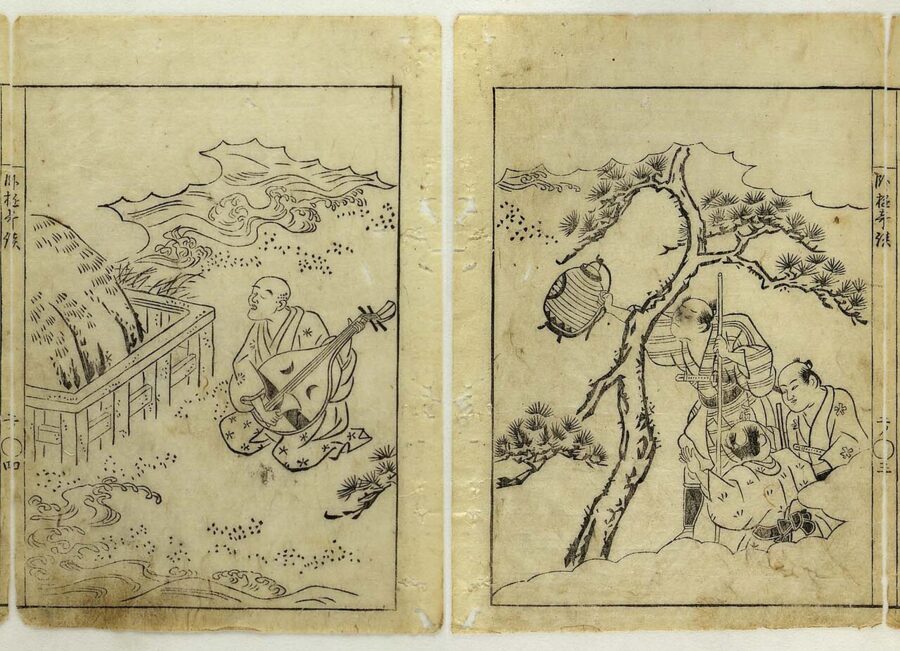
The priest discovers that the “house” is the Heike graveyard and the audience the drowned dead, so he paints the Heart Sutra, 般若心経 (Hannya Shingyō), over every part of his body except the ears. That night the samurai finds only two ears floating in the dark, tears them off to prove he came, and leaves. Hōichi survives, becomes famous, and is known ever after as 耳なし芳一 (Mimi-nashi Hōichi), “Hōichi with no ears.”
Lafcadio Hearn and Kwaidan
Lafcadio Hearn was born in 1850 on the Greek island of Lefkada, worked as a reporter in Cincinnati and New Orleans, and came to Japan in 1890. He taught in Matsue, married Koizumi Setsu, became a Japanese citizen in 1896 and took the name 小泉八雲 (Koizumi Yakumo).
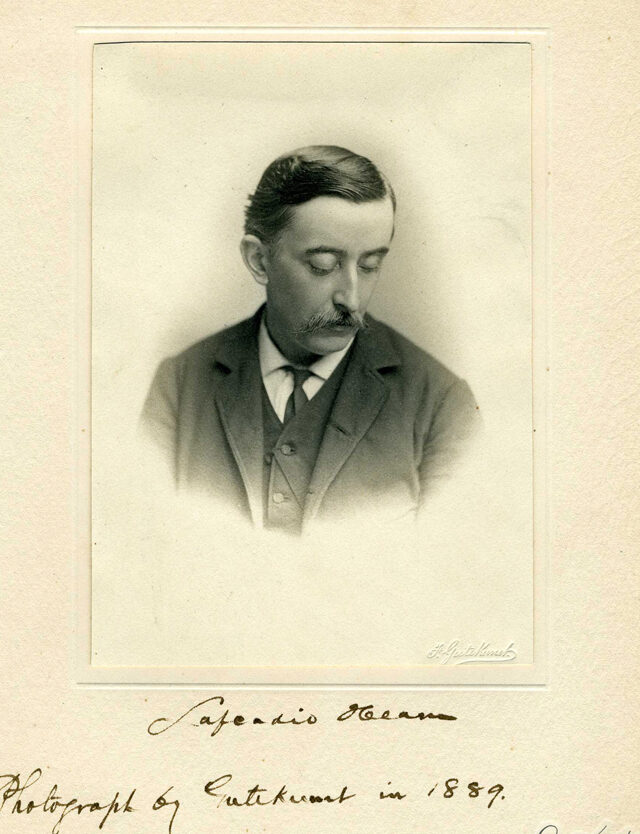
Kwaidan: Stories and Studies of Strange Things came out in 1904, a few months before he died. The spelling follows the old kana くわいだん. Setsu told him many of the stories, and he rewrote them in English. The book holds seventeen ghost stories, Hōichi and Yuki-onna among them, plus three essays on insects.
Setsu’s story reached a new audience in 2025: NHK’s morning drama Bakebake, which aired from September 2025 to March 2026, was inspired by her life with Hearn. Its title is a play on 化ける, the same verb inside obake.
Where the stories are set
Most kaidan are tied to a real street, well or temple. Hours and prices below are from the official sites as of November 2026.
Oiwa Inari, Yotsuya (Tokyo)
In Samon-chō, a quiet block of Yotsuya in Shinjuku, two shrines to Oiwa face each other across a narrow street. 於岩稲荷田宮神社 (Oiwa Inari Tamiya Jinja) stands on the site of the Tamiya family house; 於岩稲荷陽運寺 (Oiwa Inari Yōun-ji), a Nichiren temple founded in the early Shōwa period, sits on the other side. The nearest station is Yotsuya-sanchōme, about four minutes on foot from exit 3.
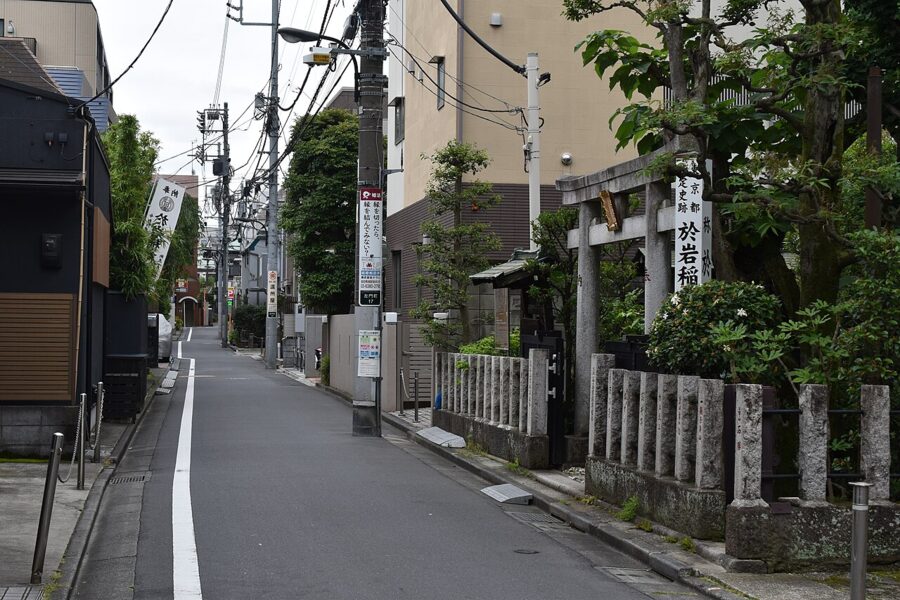

The original shrine burned in 1879 and moved to Shinkawa in Chūō Ward, near the theaters, so there is a third Oiwa Inari there; the Yotsuya shrine was rebuilt after the war. Actors still visit before staging Yotsuya Kaidan, and at Yōun-ji people also pray to end bad relationships and find good ones. Yōun-ji’s grounds are open 8:00 to 17:00.
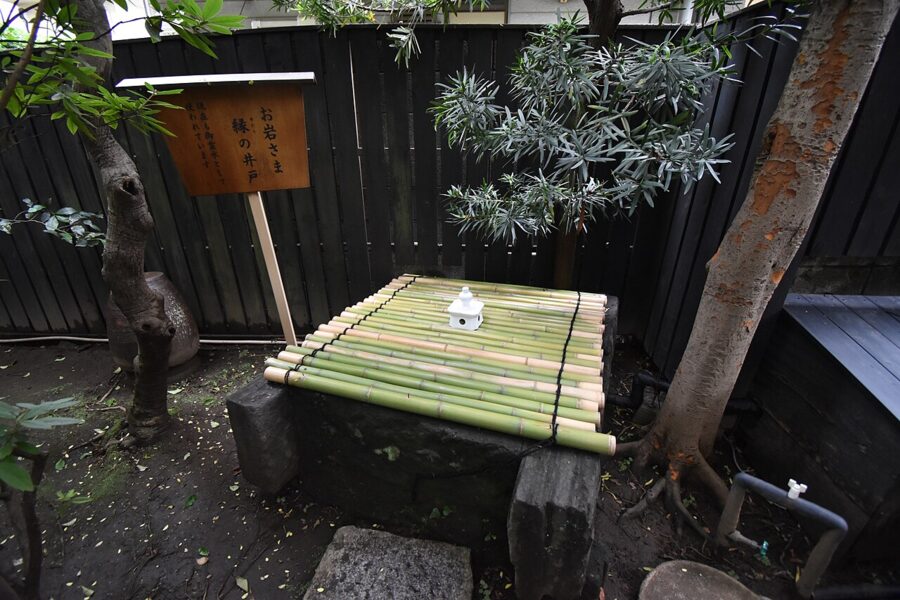

Okiku’s Well, Himeji Castle
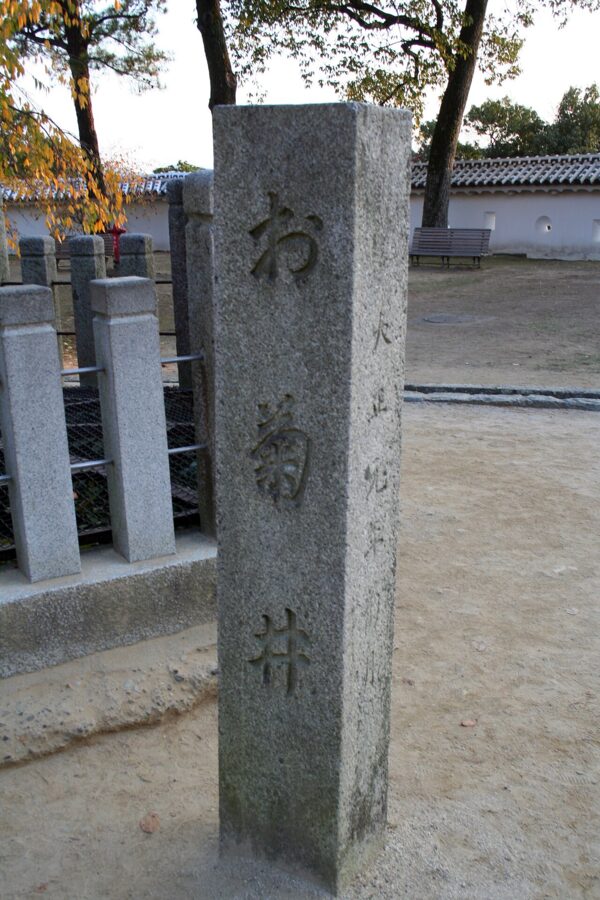
お菊井戸 (Okiku-ido) sits inside Himeji Castle in the 上山里 (Kami-yamazato) enclosure, on the way up to the keep, with a stone post and a grille over the top. The name is younger than the legend. The castle’s records call it 釣瓶取りの井戸 (tsurubetori no ido), the well where buckets were drawn, and it only became “Okiku’s Well” after the castle opened to the public in the Taishō period (1912 to 1926).
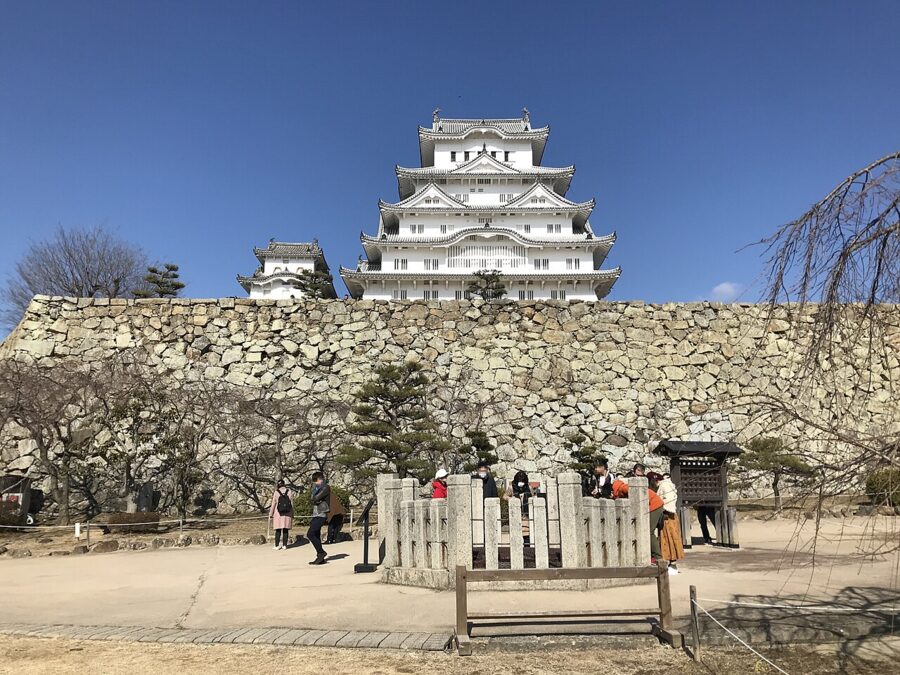

Since March 1, 2026, Himeji Castle’s admission is ¥2,500 (about $16) for visitors 18 and over; Himeji residents pay ¥1,000 (about $6), and anyone under 18 enters free. A combined ticket with the Kōko-en garden next door is ¥2,600 (about $17). The castle is open 9:00 to 17:00 with last entry at 16:00, and closed December 29 and 30.

In town, Jūnisho Shrine (十二所神社) keeps a small お菊神社 (Okiku Jinja). Himeji has one more Okiku story: in 1795 the area filled with swallowtail pupae that looked like a woman tied up with rope, and people called them お菊虫 (Okiku-mushi), Okiku’s insects. In 1989 the city adopted that butterfly, the Chinese windmill, as its symbol.
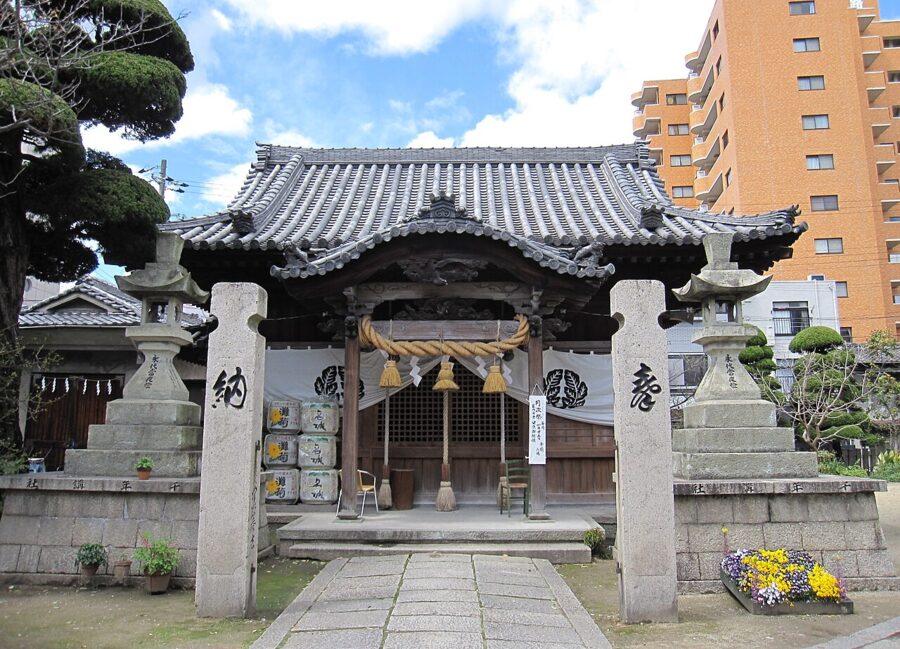

Akama Shrine, Shimonoseki
Amida-ji, Hōichi’s temple, became 赤間神宮 (Akama Jingū) when temples and shrines were forcibly separated in the Meiji era. It honors the drowned emperor Antoku, and it stands right on the Kanmon Strait, the water where the Battle of Dan-no-ura was fought.

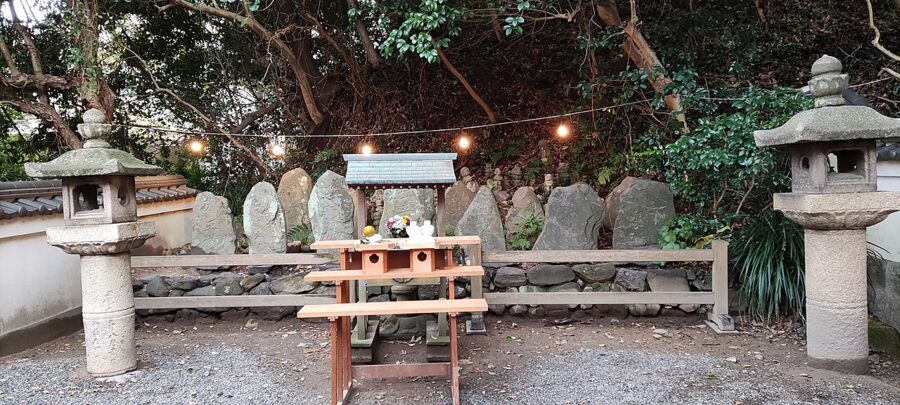
Inside the grounds, 芳一堂 (Hōichi-dō) is a small hall built in 1957 for a seated statue of Hōichi carved from camphor wood by the sculptor Oshida Masao. Close by is 七盛塚 (Shichimori-zuka), a row of memorial stones for fourteen Heike warriors and nobles, so named because so many of them have 盛 (mori) in their names.
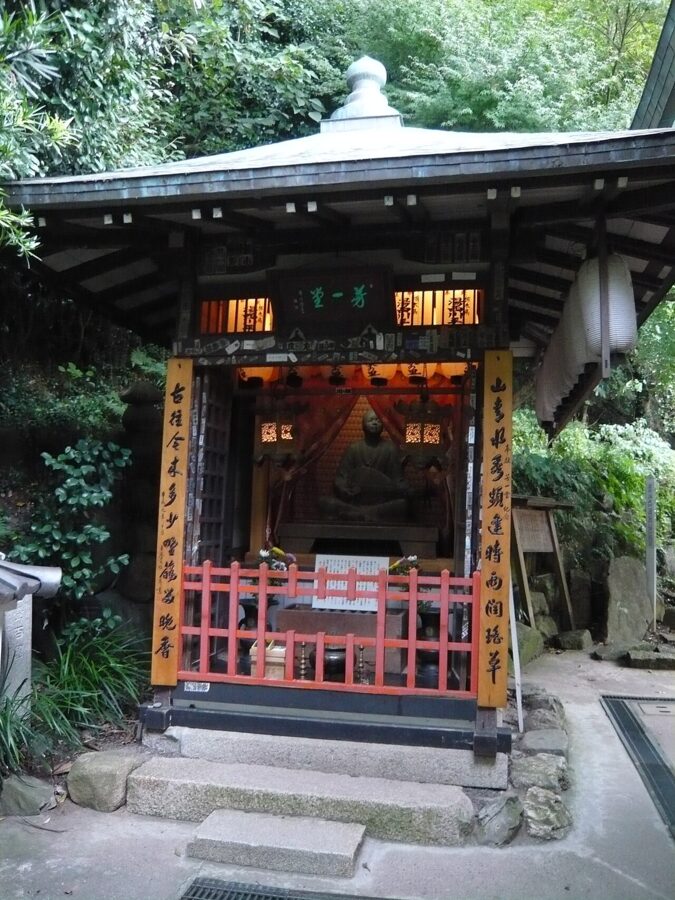
According to the shrine, a biwa memorial service for Hōichi, 耳なし芳一琵琶供養祭, is held every July 15. The shrine also runs a 12-minute Hōichi screening on Fridays and Saturdays, with wearable speakers that let you feel the biwa as well as hear it; a standard seat is ¥600 (about $4). The narration is in Japanese with Korean and traditional Chinese subtitles, so read Hearn’s version before you go.

Matsue: the Lafcadio Hearn Memorial Museum
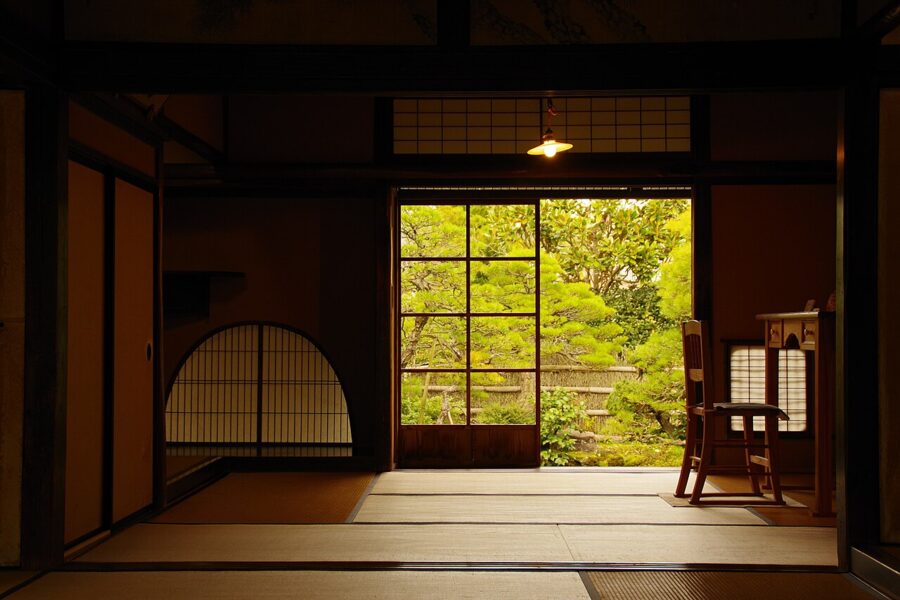
Hearn spent just over a year in Matsue, in Shimane. The 小泉八雲記念館 (Koizumi Yakumo Kinenkan) stands on Shiomi Nawate, the old samurai street by the castle moat, next door to the house he rented.
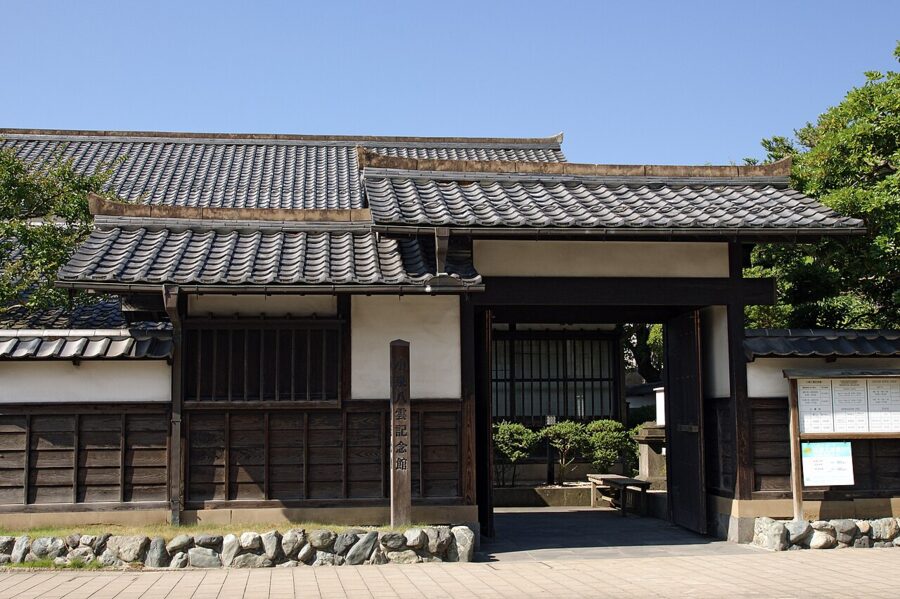

The museum’s visitor guide lists hours of 9:00 to 18:00 from April to September (last entry 17:30) and 9:00 to 17:00 from October to March (last entry 16:30). Admission is ¥600 (about $4) for adults, or ¥800 (about $5) with the former residence. From JR Matsue Station, the Lakeline loop bus takes about 16 minutes to the 小泉八雲記念館前 stop. Until June 6, 2027, a special exhibition looks at his friendship with Nishida Sentarō, the teacher who helped him settle in Matsue.
The museum also runs a Matsue Ghost Tour through the town’s own ghost stories; check its site for dates.
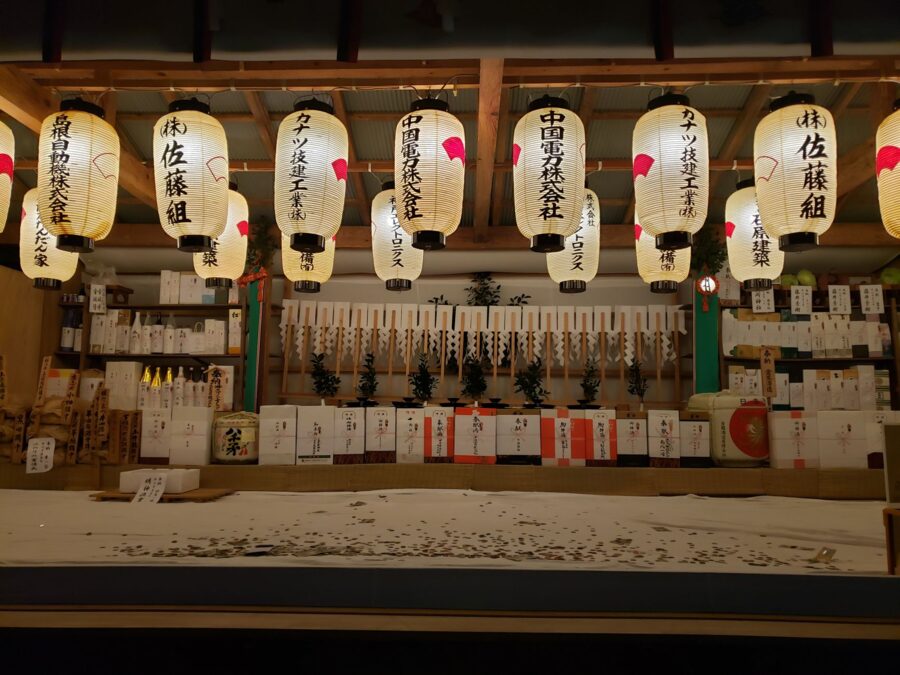
Two more for Tokyo: Yanaka and Ōme
全生庵 (Zenshō-an), a Zen temple in Yanaka, holds the grave of San’yūtei Enchō and the ghost paintings he collected. He started gathering them around 1875 for his own ghost-story evenings and hoped to reach a hundred, a hyakumonogatari in pictures, but died before he got there. The temple shows about fifty scrolls every August, around the anniversary of his death on August 11; in 2026 the Enchō festival ran August 1 to 31. It is about five minutes’ walk from Sendagi Station.
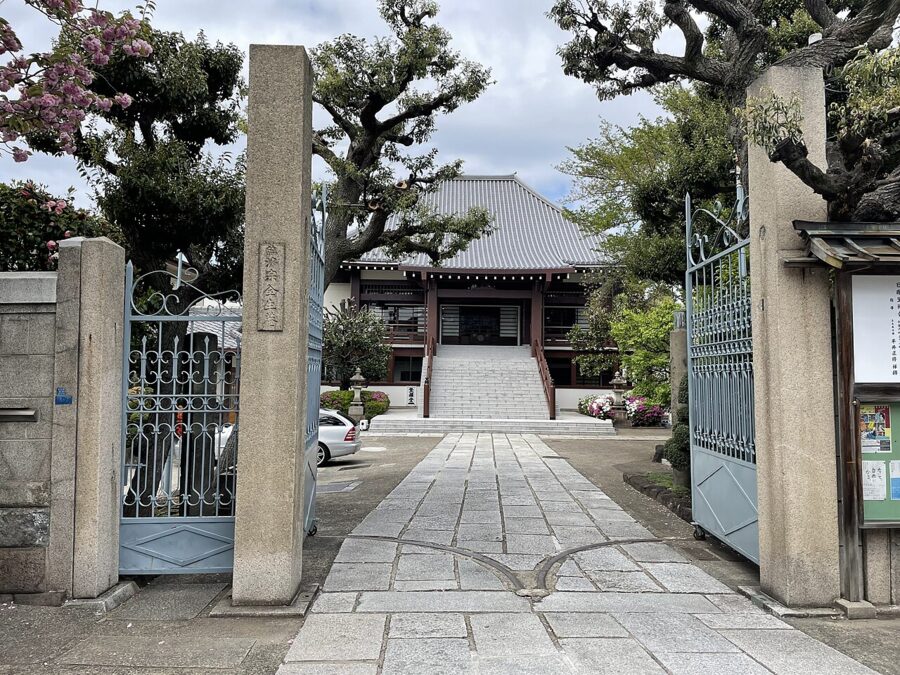
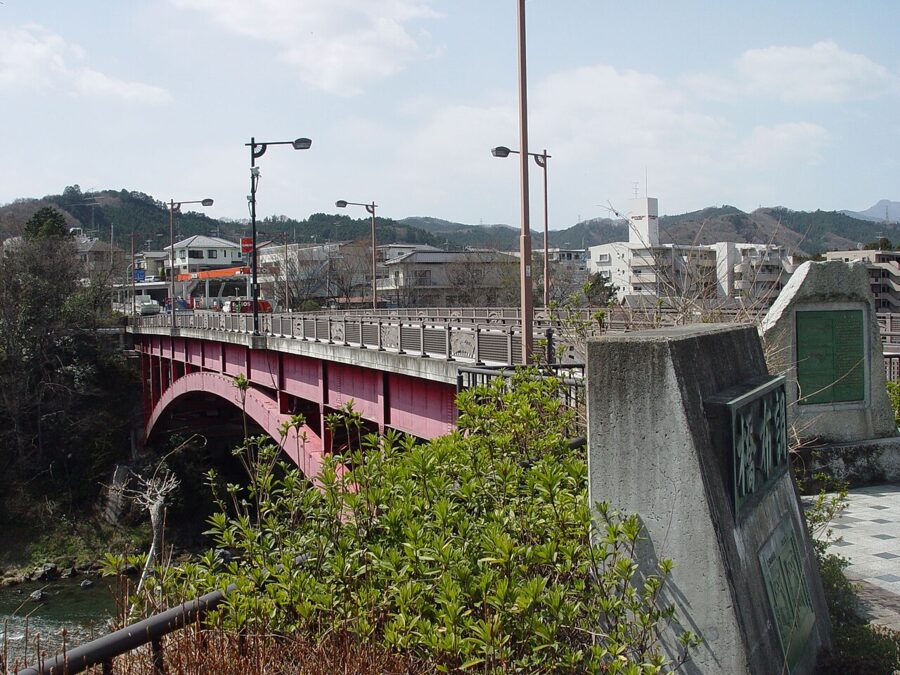
For the snow woman, take the Ōme Line west. At the foot of Chōfu Bridge (調布橋) over the Tama River in Ōme, a stone set up in 2002 marks the area as 雪おんな縁の地, “the place linked to the snow woman.” The Chōfu village Hearn wrote about is this one, not today’s Chōfu City.

Kabuki, film and the ghost season now
Kabuki made these ghosts what they are. The first Oiwa was Onoe Kikugorō III, and the role became a specialty of his acting family. In the door-flip scene one actor traditionally plays both Oiwa and the servant nailed to the other side. Noh has its own ghosts, slower and sadder, who return to dance a memory they cannot let go of.
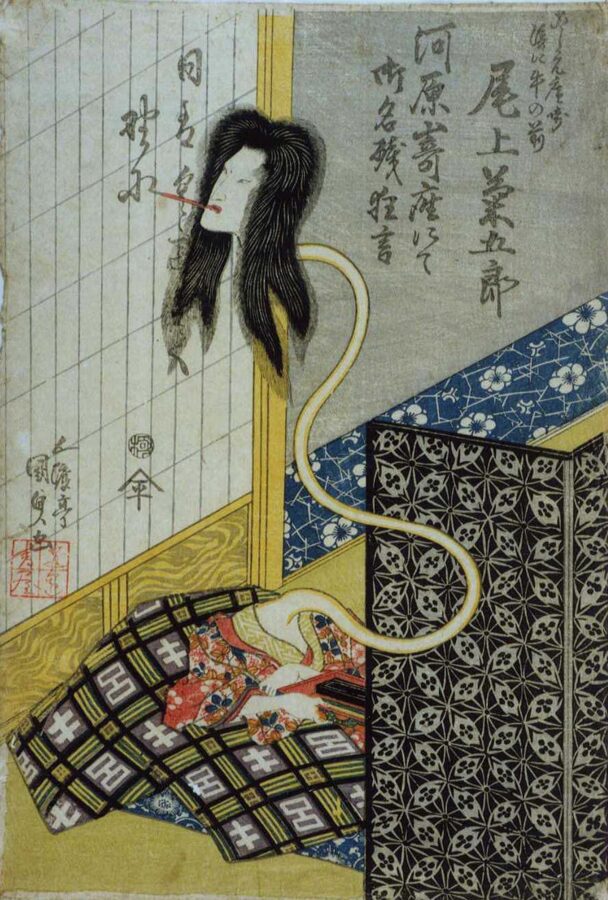
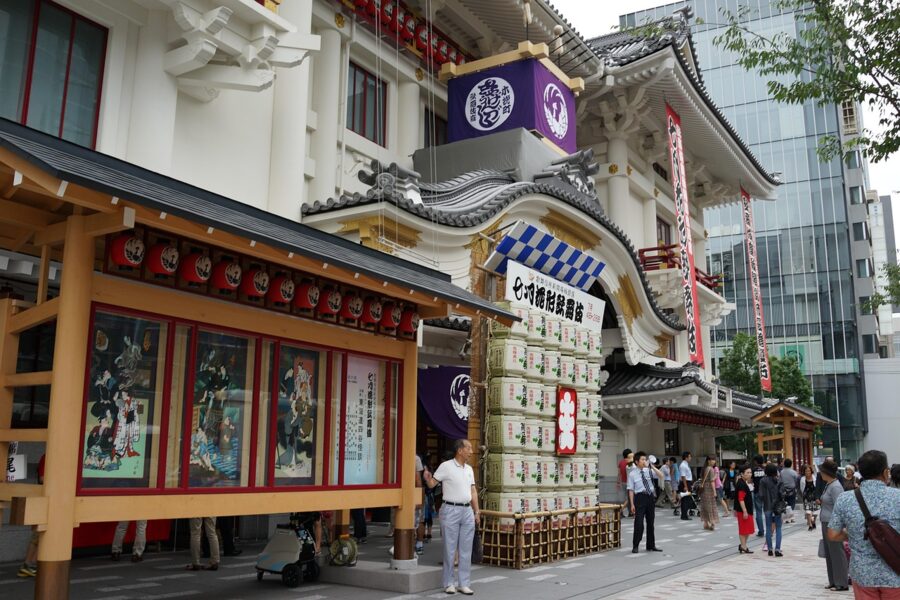
The Kabuki-za in Ginza is Tokyo’s main kabuki theater. Its program changes every month, so check the schedule for a ghost play before you buy.
On film, I would start with Nakagawa Nobuo’s Tōkaidō Yotsuya Kaidan (1959). Kobayashi Masaki’s Kwaidan (1964) adapts four of Hearn’s stories, Yuki-onna and Hōichi among them, on huge painted sets. When Ringu (1998) sent a girl in white with long black hair crawling out of a well, Japanese audiences knew exactly whose ghost she was descended from.
Today the summer ghost season lives on TV specials, in the storyteller Inagawa Junji, who has toured a summer kaidan show since the 1990s, and in school. The legends children swap, Hanako-san in the third stall of the girls’ toilet or Teke Teke dragging herself along the tracks, are 都市伝説 (toshi densetsu), urban legends from the late twentieth century with no real case behind them. Class haunted houses are a fixture of the school festival, and summer camps end with a kimodameshi in the dark.
If you want to try hyakumonogatari for yourself, you do not need a hundred wicks. Tell one short story in Japanese tonight, any story, and end it the old way: let your hands hang, lower your voice, and say うらめしや.