
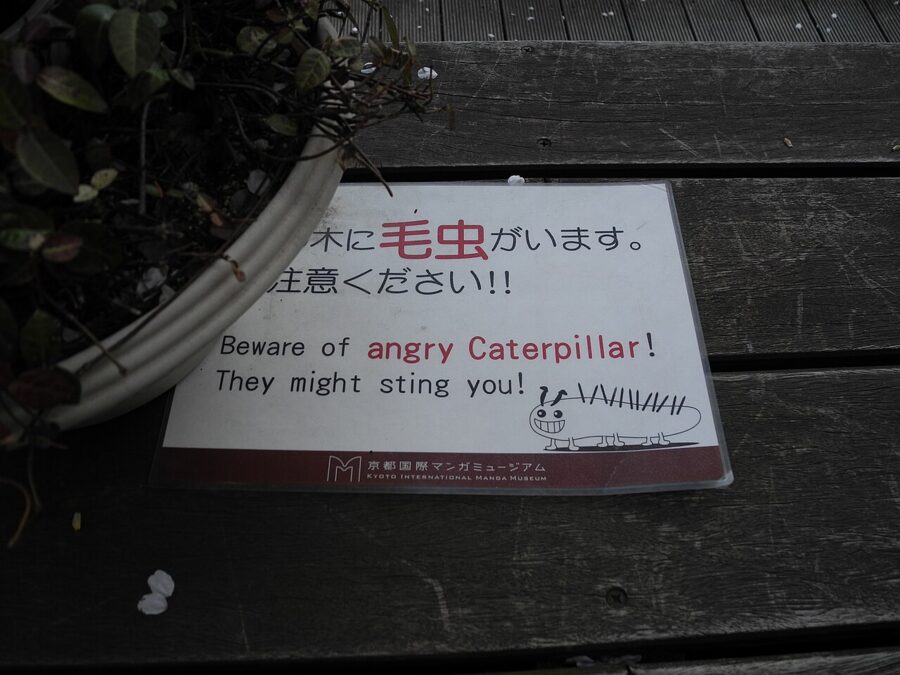
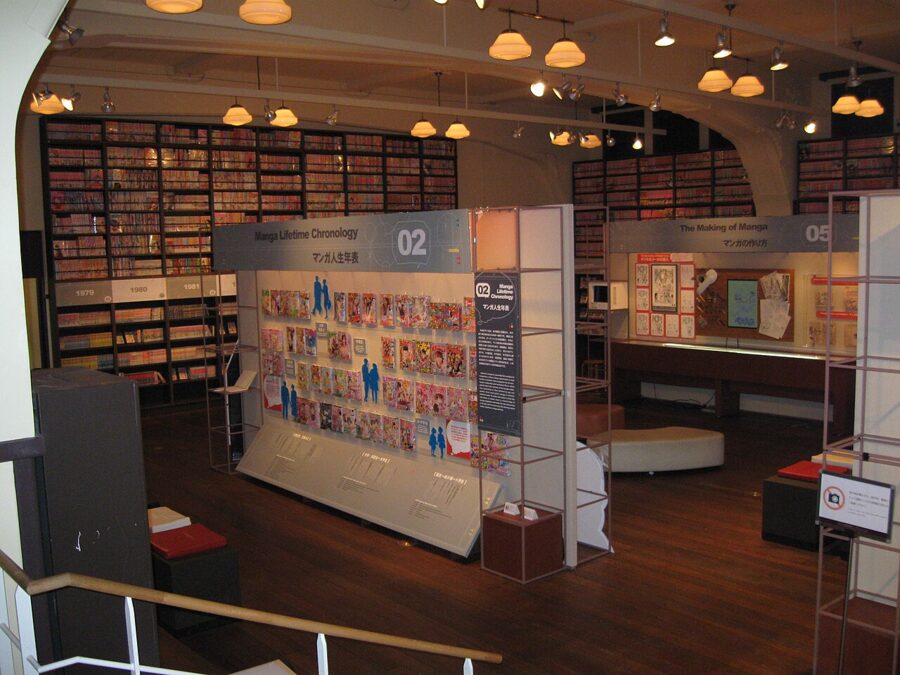
A laminated sign on a wooden deck at the Kyoto International Manga Museum holds most of beginner Japanese grammar in two lines: 木に毛虫がいます。ご注意ください!! (ki ni kemushi ga imasu, go-chūi kudasai), “There are caterpillars in the tree, please be careful.” A place marked with に, a subject marked with が, a verb waiting at the very end, and a polite request built on ください. Most of a first-year textbook is built from those same few parts.
The core rules of the Japanese language for a beginner fit in a short list: how a sentence is built, the particles that hold it together, the polite and casual forms, verbs and adjectives, questions, the ko-so-a-do words and counters. Each one below comes with real sentences in Japanese, romaji and English. After them comes the order I would learn it all in, and the places where most learners stall.
First, the question everyone asks: is Japanese grammar harder than English grammar? The Foreign Service Institute, which trains American diplomats, puts Japanese in its hardest group for English speakers, Category IV, with an estimate of 88 weeks (2,200 class hours) for a full-time student to reach a professional level. Most of that time goes on kanji and vocabulary, though. The grammar itself is unusually regular: no articles, no plurals to agree, no grammatical gender, verbs that never change for “I”, “you” or “they”, and only two truly irregular verbs.
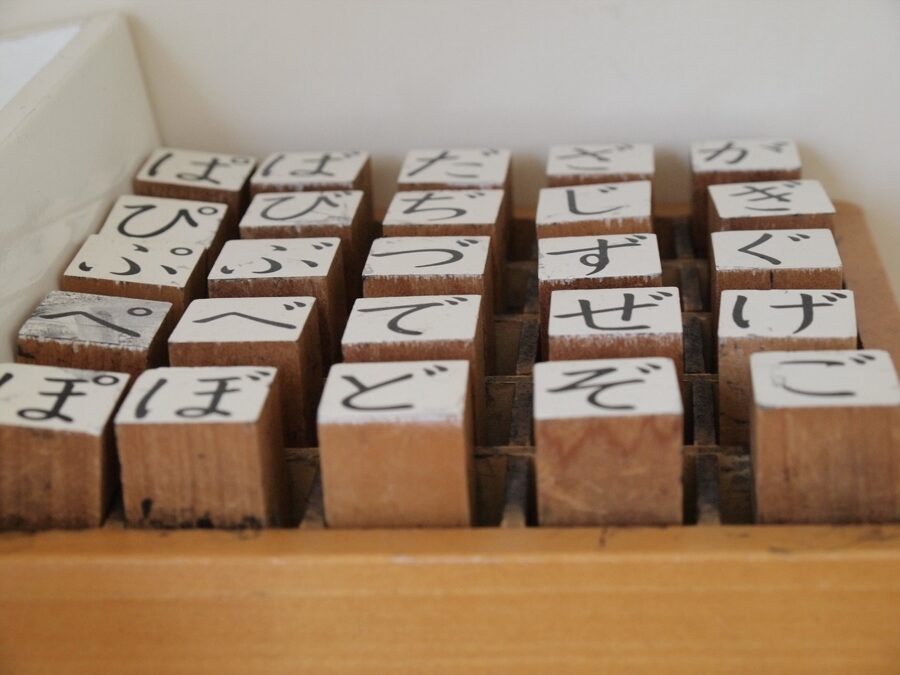
Japanese teachers describe three basic sentence types, and every beginner sentence is one of them.
A noun sentence ends in a noun plus です (desu): 学生です, “I’m a student.” An adjective sentence ends in an adjective: 高いです, “It’s expensive.” A verb sentence ends in a verb: 食べます, “I eat.” Learn how each one turns negative and past, and you have the skeleton of the language.
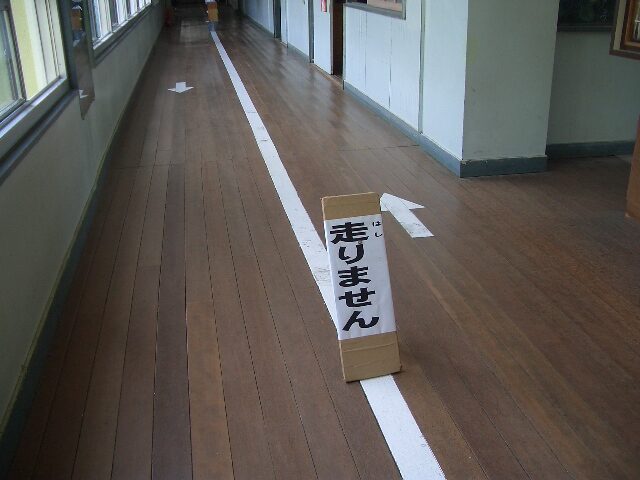

目次 Contents
- Word order: the verb goes last
- Topic and subject: wa and ga
- The core particles in one table
- Desu, masu and the casual forms
- Verbs: three groups and the te form
- I-adjectives and na-adjectives
- Asking questions
- Ko-so-a-do words
- Counting: counters in a sentence
- The order to learn it in
- Where most learners stall
Word order: the verb goes last
English runs subject, verb, object: “I eat sushi.” Japanese runs subject, object, verb: “I sushi eat.” The verb, or the adjective or noun plus です that does a verb’s job, closes the sentence, and everything else lines up in front of it. Each word before the verb carries a small tag, a particle, that says what role it plays.
| Japanese | Romaji | English |
|---|---|---|
| 私は寿司を食べます。 | watashi wa sushi o tabemasu. | I eat sushi. (polite) |
| 田中さんは毎朝コーヒーを飲みます。 | Tanaka-san wa maiasa kōhī o nomimasu. | Tanaka drinks coffee every morning. (polite) |
| 明日、京都に行きます。 | ashita, Kyōto ni ikimasu. | (I) am going to Kyoto tomorrow. (polite) |
Because the particles label each piece, the middle of the sentence can move. 毎朝田中さんはコーヒーを飲みます and 田中さんは毎朝コーヒーを飲みます mean the same thing; the first just puts “every morning” up front. The verb is the one thing that stays put, so listen for the end of a Japanese sentence before you decide what it means. A negative arrives last too, so “I eat” and “I don’t eat” sound identical until the final syllables.
What a sentence can leave out
Japanese drops anything the listener already knows. If the conversation is about you, “I” disappears; if you are both looking at the cake, “the cake” disappears. A complete, natural reply can be one verb. Learners who keep saying 私は (watashi wa) at the start of every sentence sound stiff, the way “As for me, I” would in English.
| Japanese | Romaji | English |
|---|---|---|
| A: 昼ご飯、食べた? B: うん、食べた。 | A: hirugohan, tabeta? B: un, tabeta. | A: Did you eat lunch? B: Yeah, (I) ate (it). (casual) |
| 行きますか。はい、行きます。 | ikimasu ka. hai, ikimasu. | Are (you) going? Yes, (I’m) going. (polite) |
| 分かりません。 | wakarimasen. | (I) don’t understand. (polite) |
Topic and subject: wa and ga
The particle は (written ha, read wa) marks the topic: what the sentence is about, often something already known. が (ga) marks the subject: who or what does the verb, often the new information. At beginner level, one test settles most cases. If the sentence answers “what about X”, use は; if it answers “who” or “what”, use が.
| Japanese | Romaji | English |
|---|---|---|
| 私は学生です。 | watashi wa gakusei desu. | I’m a student. (As for me, student.) (polite) |
| だれが来ましたか。田中さんが来ました。 | dare ga kimashita ka. Tanaka-san ga kimashita. | Who came? Tanaka came. (polite) |
| 肉は食べますが、魚は食べません。 | niku wa tabemasu ga, sakana wa tabemasen. | Meat I eat, but fish I don’t. (polite) |
A few patterns take が by habit, and learning them as fixed frames saves a lot of guessing.
Question words such as だれ (dare, who) and 何 (nani, what) always take が as subjects, never は. Existence uses が: 猫がいます, “there’s a cat.” Liking, disliking, skill and understanding put the thing liked or understood before が: 私は日本語が分かります, “I understand Japanese.” The third example in the table shows the other habit: は sets two things side by side to contrast them.

The core particles in one table
Particles sit after the word they mark, never before it. Ten of them carry almost every beginner sentence. Three are written with one kana and read with another: は is read wa, へ is read e, and を is read o.
| Particle | Main job | Example | Romaji | English |
|---|---|---|---|---|
| は (wa) | topic | 東京は大きいです。 | Tōkyō wa ōkii desu. | Tokyo is big. (polite) |
| が (ga) | subject, new information | 雨が降っています。 | ame ga futte imasu. | It’s raining. (polite) |
| を (o) | direct object | 水を飲みます。 | mizu o nomimasu. | I drink water. (polite) |
| に (ni) | time, destination, where something is, to whom | 七時に起きます。 | shichi-ji ni okimasu. | I get up at seven. (polite) |
| で (de) | where an action happens; by means of | 電車で行きます。 | densha de ikimasu. | I go by train. (polite) |
| へ (e) | direction, toward | 日本へ行きます。 | Nihon e ikimasu. | I’m going to Japan. (polite) |
| と (to) | and (complete lists); with | 友だちと映画を見ました。 | tomodachi to eiga o mimashita. | I saw a film with a friend. (polite) |
| も (mo) | also, too (replaces は, が and を) | 私も行きます。 | watashi mo ikimasu. | I’m going too. (polite) |
| の (no) | possession; joins two nouns | 私の本です。 | watashi no hon desu. | It’s my book. (polite) |
| か (ka) | question marker at the end | 学生ですか。 | gakusei desu ka. | Are you a student? (polite) |
Ni or de?
The pair that causes the most mistakes after wa and ga is に and で, because both translate as “in” or “at”. に marks where something exists or ends up; で marks where something happens. Ask yourself whether the verb is an action or a state.
| Japanese | Romaji | English |
|---|---|---|
| 図書館にいます。 | toshokan ni imasu. | I’m at the library. (polite; existence, に) |
| 図書館で勉強します。 | toshokan de benkyō shimasu. | I study at the library. (polite; action, で) |
| ここに名前を書いてください。 | koko ni namae o kaite kudasai. | Please write your name here. (polite; where the name ends up, に) |

Desu, masu and the casual forms
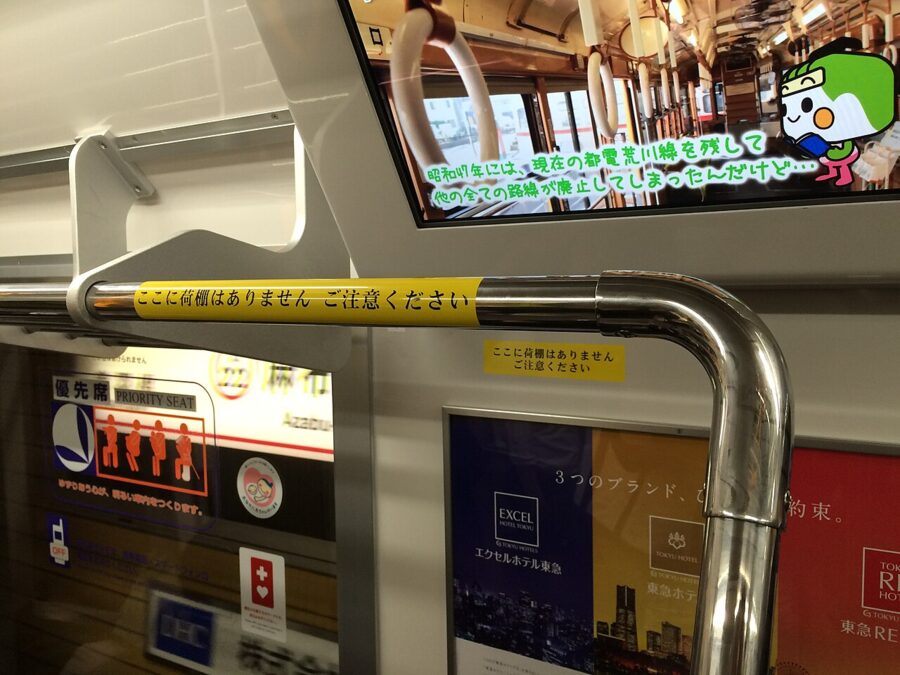
Japanese marks politeness in the grammar itself, at the end of the sentence. With strangers, shop staff, teachers and anyone older you have just met, use the polite style: です after nouns and adjectives, ます on verbs. With friends and family, use the plain style. Textbooks start with the polite style for good reason: it is never rude, and you will hear it at every shop counter.
| Polite (desu/masu) | Casual (plain) | |
|---|---|---|
| It’s a book. | 本です。(hon desu.) | 本だ。(hon da.) or just 本。 |
| It isn’t a book. | 本じゃありません。(hon ja arimasen.) | 本じゃない。(hon ja nai.) |
| I eat. | 食べます。(tabemasu.) | 食べる。(taberu.) |
| I don’t eat. | 食べません。(tabemasen.) | 食べない。(tabenai.) |
| I ate. | 食べました。(tabemashita.) | 食べた。(tabeta.) |
| I didn’t eat. | 食べませんでした。(tabemasen deshita.) | 食べなかった。(tabenakatta.) |
That table covers present, past, positive and negative, which is all the tense Japanese has. There is no separate future: 明日行きます (ashita ikimasu) is “I’ll go tomorrow”, and a time word does the work. Notice also that the casual 食べる is the form you find in a dictionary, which is why teachers call it the dictionary form.
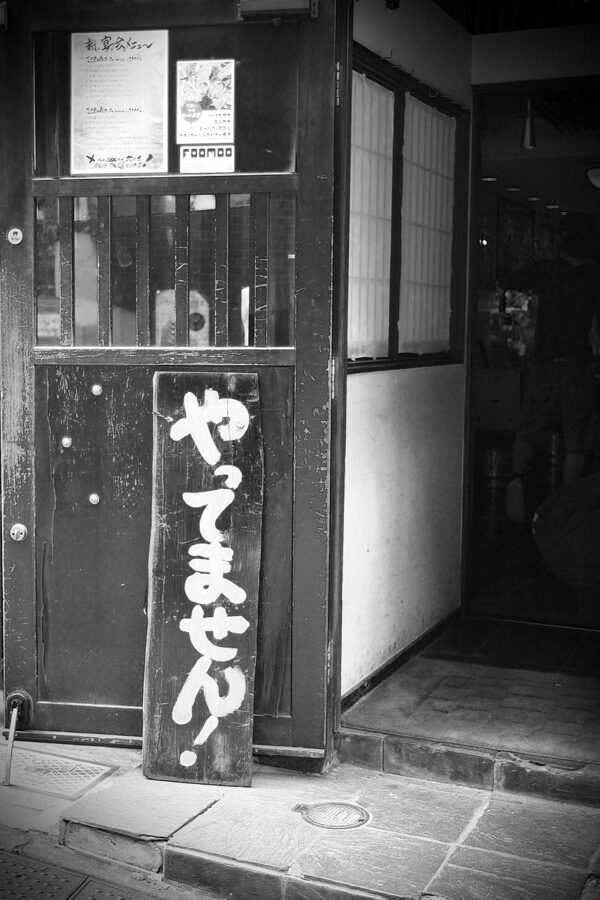
Two phrases from the questions learners type most show the two styles side by side. “I’m sorry” is すみません (sumimasen, polite), ごめんなさい (gomen nasai, polite but warmer, to people you know) or ごめん (gomen, casual). Inviting someone to go somewhere together is 行きましょうか (ikimashō ka, polite) as a question, 行きましょう (ikimashō, polite) as a cheerful “time to go”, or 行こう (ikō, casual) among friends.
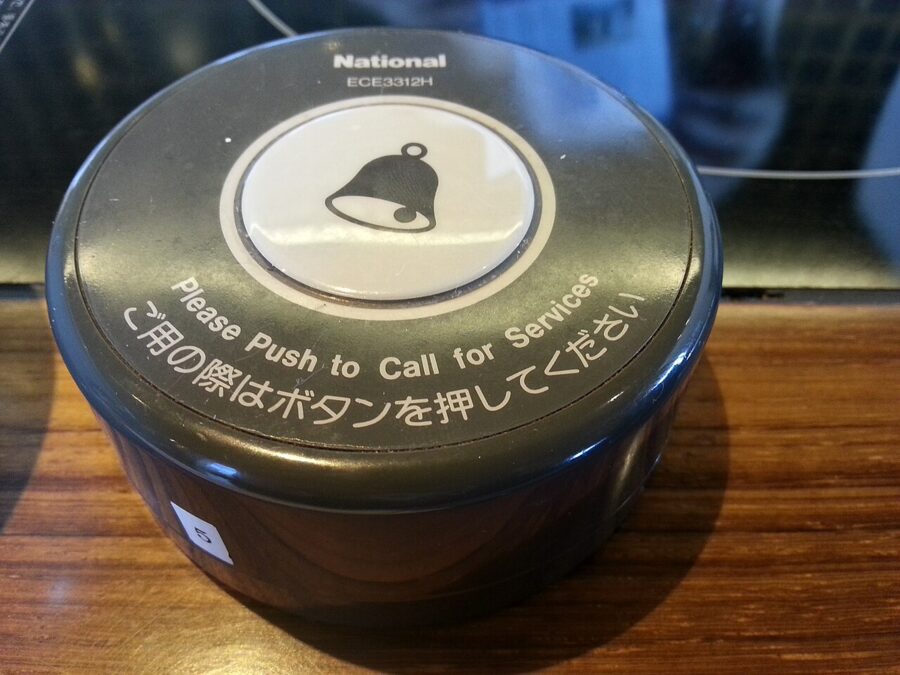
Above the desu/masu style sits keigo, the formal honorific and humble language of business and service. You will hear it before you need to produce it: いらっしゃいませ (irasshaimase, “welcome”, formal) at a shop door, お待ちください (o-machi kudasai, “please wait”, formal) at a counter. These politeness levels follow the lines of in-group and out-group that run through Japanese culture, and they are an N4 and N3 topic, not a first-month one.
Verbs: three groups and the te form
Every Japanese verb ends in an u-sound in its dictionary form: 書く (kaku), 飲む (nomu), 食べる (taberu), する (suru). They fall into three groups, and the group tells you how to conjugate the verb. Once you know a verb’s group, its forms follow a pattern with almost no surprises.
| Group | What it looks like | Dictionary form | Masu form | Negative (casual) |
|---|---|---|---|---|
| Group 1: u-verbs (godan) | ends in any u-sound; final sound shifts | 書く (kaku), write | 書きます (kakimasu) | 書かない (kakanai) |
| Group 2: ru-verbs (ichidan) | ends in -iru or -eru; drop る | 食べる (taberu), eat | 食べます (tabemasu) | 食べない (tabenai) |
| Group 3: irregular | only two | する (suru), do; 来る (kuru), come | します (shimasu); 来ます (kimasu) | しない (shinai); 来ない (konai) |
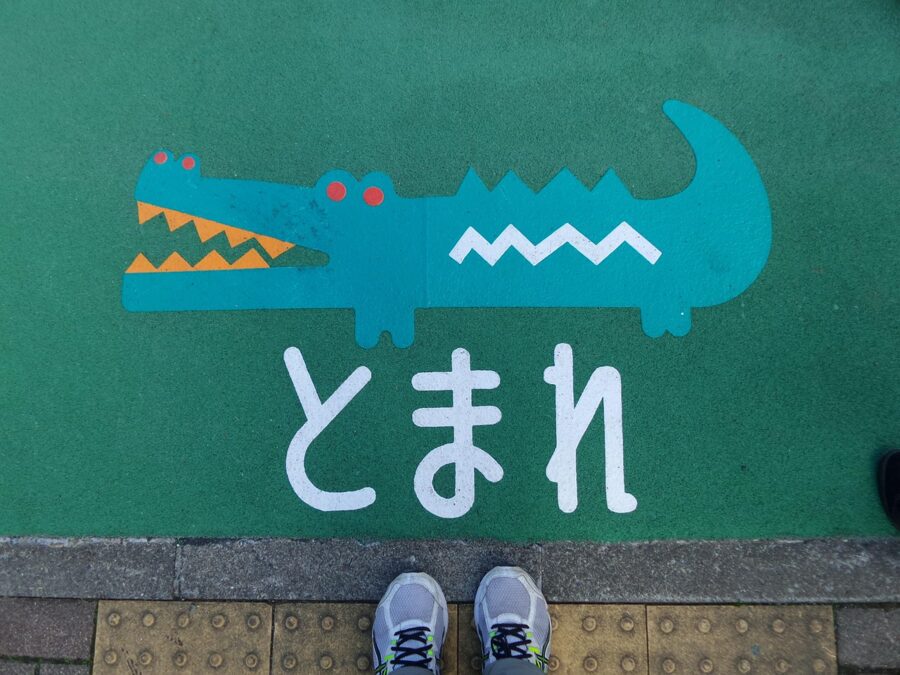
The trap is that a few common verbs ending in -iru or -eru are actually group 1. 帰る (kaeru, go home), 入る (hairu, enter), 走る (hashiru, run), 知る (shiru, know), 切る (kiru, cut) and 要る (iru, need) all conjugate like u-verbs: 帰ります (kaerimasu), 帰らない (kaeranai). Learn those six as a list and the guessing mostly stops.
Why Japanese schools count five groups
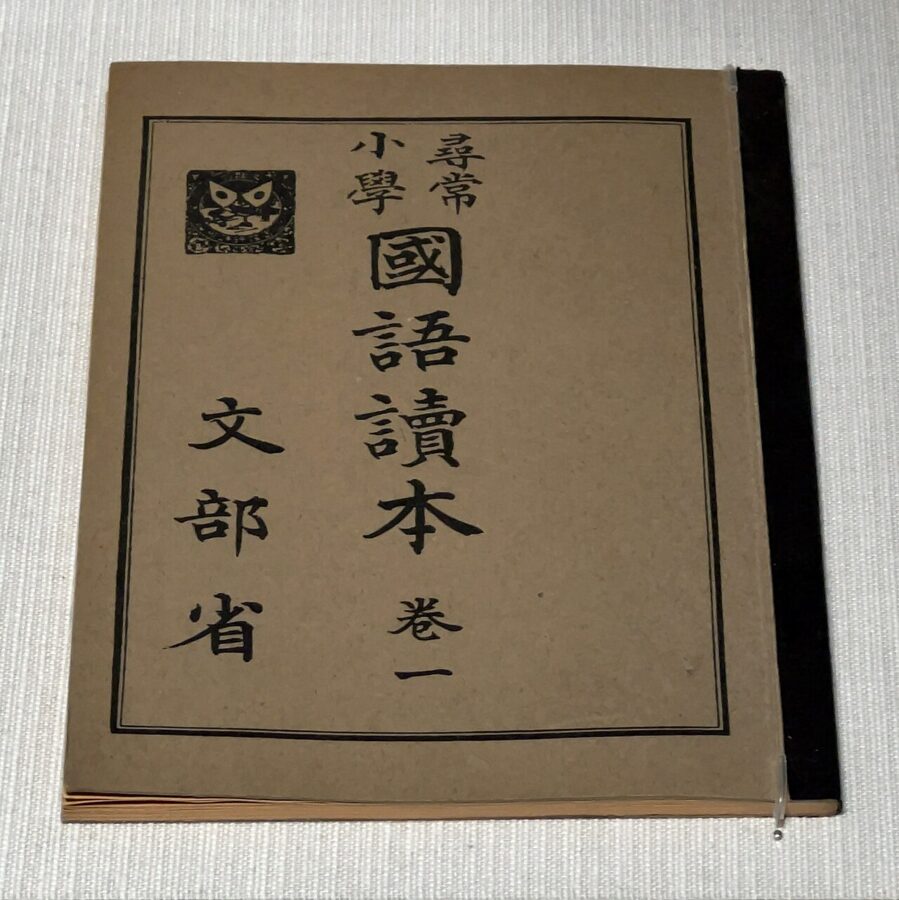
Japanese children learn the same verbs in a different frame. School grammar, the 学校文法 (gakkō bunpō) taught in 国語 (kokugo) classes, sorts verbs into five conjugation classes: 五段 (godan), 上一段 (kami ichidan), 下一段 (shimo ichidan), カ変 (ka-hen, just 来る) and サ変 (sa-hen, する and its compounds). Textbooks for foreign learners merge the two ichidan classes into group 2 and the two irregulars into group 3. If a Japanese friend says 五段動詞, they mean your group 1.
The te form in outline
The te form is the hinge of beginner Japanese. On its own it links actions (“I got up and ate”); with ください it makes a polite request; with いる it makes an ongoing action or a resulting state. Group 2 verbs are easy: drop る and add て. Group 1 verbs change by their last sound.
| Dictionary form ends in | Te form ends in | Example |
|---|---|---|
| う, つ, る | って | 買う → 買って (katte), 待つ → 待って (matte), 帰る → 帰って (kaette) |
| む, ぶ, ぬ | んで | 読む → 読んで (yonde), 遊ぶ → 遊んで (asonde), 死ぬ → 死んで (shinde) |
| く | いて | 書く → 書いて (kaite); but 行く → 行って (itte) |
| ぐ | いで | 泳ぐ → 泳いで (oyoide) |
| す | して | 話す → 話して (hanashite) |
| Group 2: る | て | 食べる → 食べて (tabete), 見る → 見て (mite) |
| Group 3 | irregular | する → して (shite), 来る → 来て (kite) |
| Japanese | Romaji | English |
|---|---|---|
| 朝ご飯を食べて、学校に行きました。 | asagohan o tabete, gakkō ni ikimashita. | I ate breakfast and went to school. (polite) |
| ゆっくり話してください。 | yukkuri hanashite kudasai. | Please speak slowly. (polite) |
| 今、本を読んでいます。 | ima, hon o yonde imasu. | I’m reading a book now. (polite) |

I-adjectives and na-adjectives
Japanese has two kinds of adjective, and they conjugate differently. I-adjectives end in い and conjugate themselves, almost like verbs: 高い (takai) becomes 高くない (takakunai) and 高かった (takakatta). Na-adjectives behave like nouns: they take な before a noun and lean on です or だ for tense. In Japanese school grammar the second kind has its own name, 形容動詞 (keiyōdōshi).
| I-adjective: 高い (takai), expensive | Na-adjective: 静か (shizuka), quiet | |
|---|---|---|
| Before a noun | 高い店 (takai mise), an expensive shop | 静かな部屋 (shizuka na heya), a quiet room |
| Present (polite) | 高いです (takai desu) | 静かです (shizuka desu) |
| Negative (polite) | 高くないです (takakunai desu) | 静かじゃありません (shizuka ja arimasen) |
| Past (polite) | 高かったです (takakatta desu) | 静かでした (shizuka deshita) |
| Past negative (casual) | 高くなかった (takakunakatta) | 静かじゃなかった (shizuka ja nakatta) |
Two catches. いい (ii, good) conjugates from its older form よい, so “it was good” is よかった (yokatta), never いかった. And a handful of na-adjectives end in い and look like the other kind: きれい (kirei, pretty or clean), 嫌い (kirai, disliked) and 有名 (yūmei, famous) all take な.
| Japanese | Romaji | English |
|---|---|---|
| このラーメンはおいしいです。 | kono rāmen wa oishii desu. | This ramen is delicious. (polite) |
| 昨日は寒かった。 | kinō wa samukatta. | It was cold yesterday. (casual) |
| 京都はきれいな町です。 | Kyōto wa kirei na machi desu. | Kyoto is a beautiful city. (polite) |

Asking questions
To turn a polite statement into a question, add か at the end. No words move, and there is no “do” or “does” to add. In writing, a question with か often ends in a full stop rather than a question mark.
Question words sit exactly where the answer will go. “Where is the station?” is 駅はどこですか (eki wa doko desu ka), and the answer is 駅はあそこです (eki wa asoko desu), “The station is over there.” The common ones: 何 (nani or nan, what), だれ (dare, who), どこ (doko, where), いつ (itsu, when), どれ (dore, which one), いくら (ikura, how much), いくつ (ikutsu, how many) and どうして (dōshite, why).
| Japanese | Romaji | English |
|---|---|---|
| これは何ですか。 | kore wa nan desu ka. | What is this? (polite) |
| トイレはどこですか。 | toire wa doko desu ka. | Where is the toilet? (polite) |
| 明日来る? | ashita kuru? | Are you coming tomorrow? (casual, rising tone) |
In casual speech か usually drops away and a rising tone does the job, as in the last example. A casual question that ends in plain か can sound blunt, so leave it out until you hear how your friends talk. “Yes” is はい (hai) and “no” is いいえ (iie), but in real conversation people more often answer by repeating the verb: 行きますか。はい、行きます。
Ko-so-a-do words
Japanese has a tidy set of “this, that, which” words built on four prefixes. こ (ko) is near the speaker, そ (so) is near the listener, あ (a) is far from both, and ど (do) asks which. Learn one row and the others fall into place.
| ko (near me) | so (near you) | a (over there) | do (which?) | |
|---|---|---|---|---|
| thing | これ (kore) | それ (sore) | あれ (are) | どれ (dore) |
| + noun | この (kono) | その (sono) | あの (ano) | どの (dono) |
| place | ここ (koko) | そこ (soko) | あそこ (asoko) | どこ (doko) |
| direction, polite | こちら (kochira) | そちら (sochira) | あちら (achira) | どちら (dochira) |
| way, manner | こう (kō) | そう (sō) | ああ (ā) | どう (dō) |
これ, それ and あれ stand alone; この, その and あの must have a noun after them. That is the mistake beginners make most here: このは高いです is wrong, and both これは高いです and この本は高いです are right. こちら is also the polite way to say “this person”: こちらは田中さんです (kochira wa Tanaka-san desu), “This is Tanaka.”
| Japanese | Romaji | English |
|---|---|---|
| それは私のかさです。 | sore wa watashi no kasa desu. | That (by you) is my umbrella. (polite) |
| あの店は安いです。 | ano mise wa yasui desu. | That shop over there is cheap. (polite) |
| どの電車に乗りますか。 | dono densha ni norimasu ka. | Which train are you taking? (polite) |

Counting: counters in a sentence
Japanese does not count things with bare numbers. A number takes a counter, a suffix chosen by the shape or kind of the thing: flat things, long things, people, small animals, machines. Start with the native “one thing, two things” set, which works for almost any object when you forget the right counter: 一つ (hitotsu), 二つ (futatsu), 三つ (mittsu), up to 十 (tō).
| Counter | Used for | 1, 2, 3 |
|---|---|---|
| つ (tsu) | general objects, up to ten | 一つ hitotsu, 二つ futatsu, 三つ mittsu |
| 人 (nin) | people | 一人 hitori, 二人 futari, 三人 sannin |
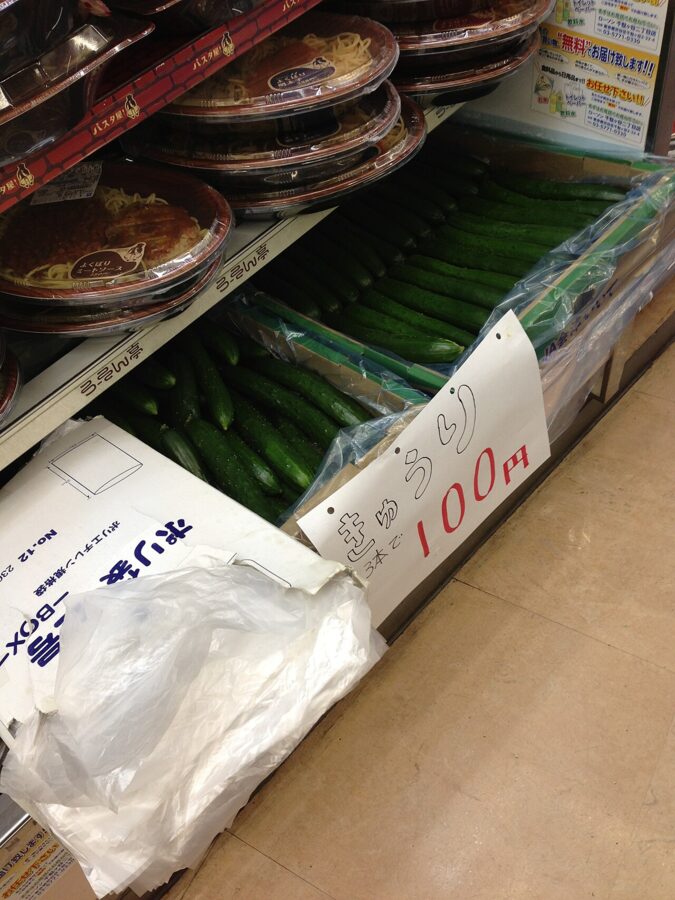
| 本 (hon) | long, thin things: bottles, pens, trains, cucumbers | 一本 ippon, 二本 nihon, 三本 sanbon |
| 枚 (mai) | flat things: paper, tickets, shirts | 一枚 ichimai, 二枚 nimai, 三枚 sanmai |
| 個 (ko) | small, compact things: eggs, apples | 一個 ikko, 二個 niko, 三個 sanko |
| 匹 (hiki) | small animals: cats, dogs, fish | 一匹 ippiki, 二匹 nihiki, 三匹 sanbiki |
| 冊 (satsu) | books, notebooks | 一冊 issatsu, 二冊 nisatsu, 三冊 sansatsu |
| 杯 (hai) | cups, glasses, bowls | 一杯 ippai, 二杯 nihai, 三杯 sanbai |
The position is what textbooks often skip. In the most natural pattern, the number and counter come after the noun and its particle, right before the verb, with no particle of their own. You can also put the number before the noun with の, which sounds a little more like a written description.
| Japanese | Romaji | English |
|---|---|---|
| りんごを三つ買いました。 | ringo o mittsu kaimashita. | I bought three apples. (polite) |
| ビールを二本ください。 | bīru o nihon kudasai. | Two bottles of beer, please. (polite) |
| 猫が一匹います。 | neko ga ippiki imasu. | There’s one cat. (polite) |
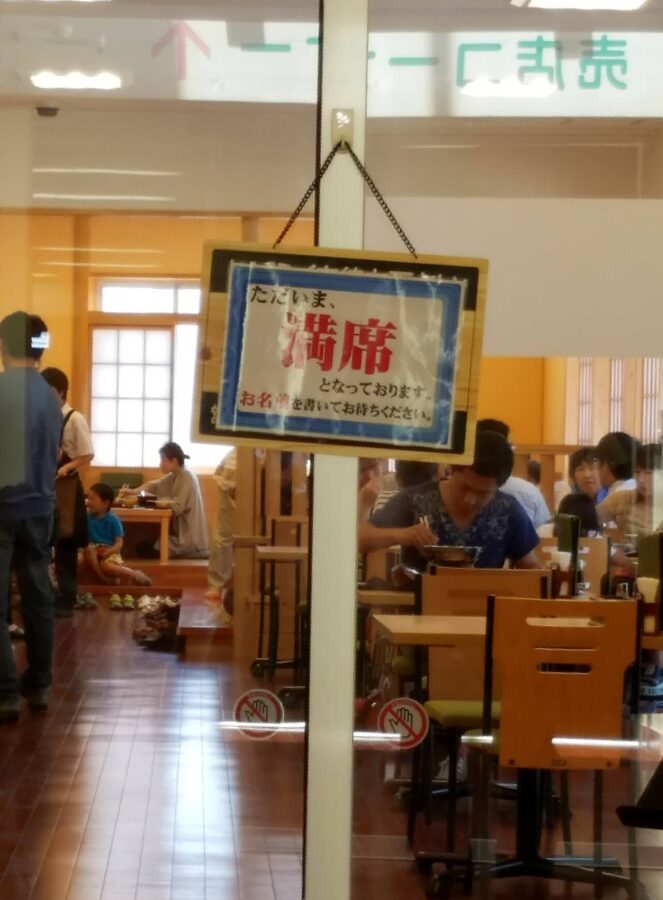
Ordering Japanese food is where counters earn their keep. At a restaurant door, staff will ask 何名様ですか (nanmei-sama desu ka, “how many in your party?”, formal), and 二人です (futari desu, “two”, polite) or a raised pair of fingers gets you a table. The sound changes (ippon, sanbon) look random at first but repeat across counters, so learn 本 well and the others come easier.

The order to learn it in
The JLPT has not published an official grammar list since its 2010 revision, so no one can hand you the “correct” syllabus for N5 or N4. The order below follows what the major beginner courses share, and it obeys one rule: never learn a pattern before the forms it is built from. Each stage lets you say more with what you already have.
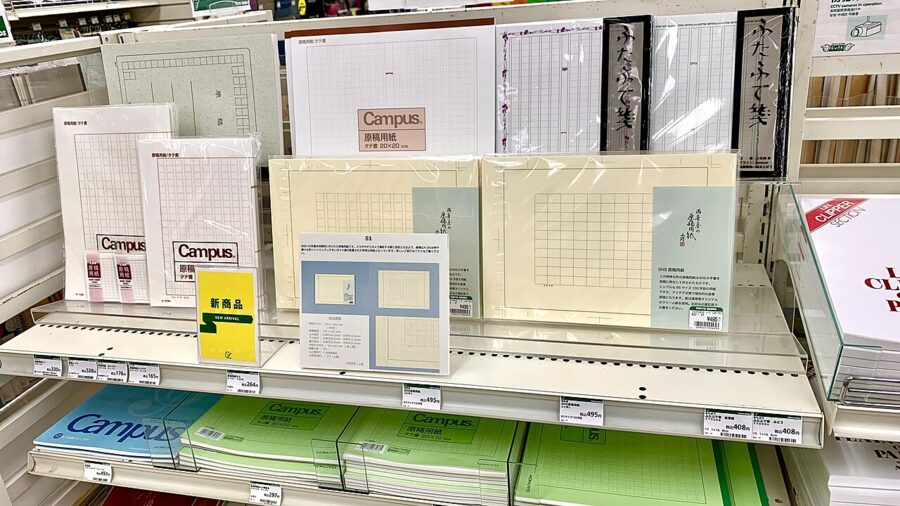
- Kana. Hiragana, then katakana. Romaji is a crutch that gets harder to drop the longer you lean on it.
- Noun sentences. X は Y です, じゃありません, ですか, の, and これ, それ, あれ. With these alone you can introduce yourself and name things.
- Adjectives. I- and na-adjectives, positive and negative, present and past. 好き (suki) and 嫌い (kirai) with が.
- Masu verbs and the action particles. ます, ません, ました, ませんでした, with を, に, で, へ and と. Time words and frequency words (よく, ときどき, 全然).
- Existence and counting. あります for things, います for people and animals, location words (上, 下, 中), counters and いくら.
- Wants and invitations. 〜たい (want to), 〜がほしい (want something), 〜ませんか and 〜ましょう. All of these use the masu stem you already know.
- The te form. てください, ている, てもいいです, てはいけません, and linking actions with て.
- Plain forms. Dictionary, ない and た forms, casual speech, と思います (to omoimasu, I think), and plain forms in front of nouns.
- Toward N4. Comparisons (より, のほうが, いちばん), experience (たことがある), lists of actions (たり〜たり), giving and receiving (あげる, くれる, もらう).
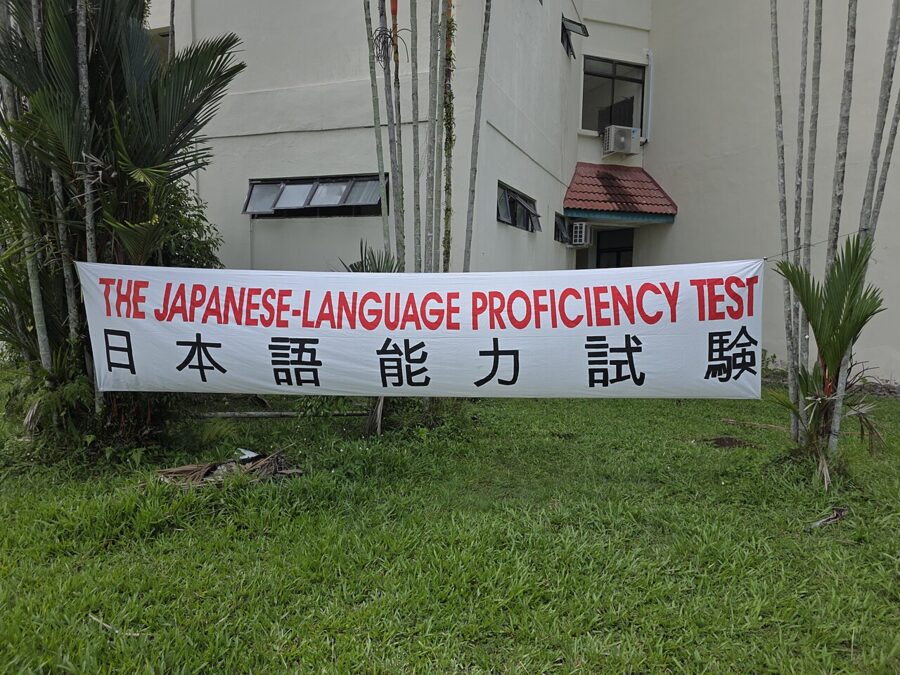
I would treat stages 1 to 7 as N5 territory and stages 8 and 9 as the start of N4. As of November 2026, the JLPT runs twice a year, in July and December, and the 2026 sittings fall on Sunday, July 5 and Sunday, December 6; some cities outside Japan hold only one of the two. N5 asks you to read “typical expressions and sentences” in hiragana, katakana and basic kanji, which is where the grammar above gets tested.
For a free course, the Japan Foundation’s Irodori textbooks run from Starter (A1) through Elementary 1 and 2 (A2) to Pre-Intermediate (A2/B1), as PDFs with audio you can download at no cost. They teach grammar inside everyday tasks rather than as rules, so pair them with a reference. Makino and Tsutsui’s A Dictionary of Basic Japanese Grammar (The Japan Times) is the reference I would keep beside any textbook: each entry takes one pattern, shows how it is formed and sets it against the patterns it gets confused with. Keep your vocabulary flashcards for words; grammar sticks better from whole sentences you have heard and said aloud.

Where most learners stall
Beginner courses lose people at the same few places. None of them is a wall; each is a pattern you need to meet a few hundred times before it feels natural. Knowing where they are helps you slow down at the right moment instead of deciding Japanese is not for you.
The te form
The te form arrives about halfway through a first-year course, and it is the first time the u-verbs change their shape in ways that need rules. Most learners memorize the table, forget it, and memorize it again. A song or chant helps, but what fixes it is using てください and ている every day for a month. Drill the forms on verbs you already use, not new ones.

Wa and ga, again
The beginner rules above get you through N5. After that, は and が start doing subtler work, especially inside longer sentences, where the subject of a smaller clause takes が even when the main topic takes は: 私は田中さんが作ったケーキを食べました (watashi wa Tanaka-san ga tsukutta kēki o tabemashita, polite), “I ate the cake Tanaka made.” Expect to keep refining this for years. Native speakers cannot explain it well either; they just hear it.
Switching to plain forms
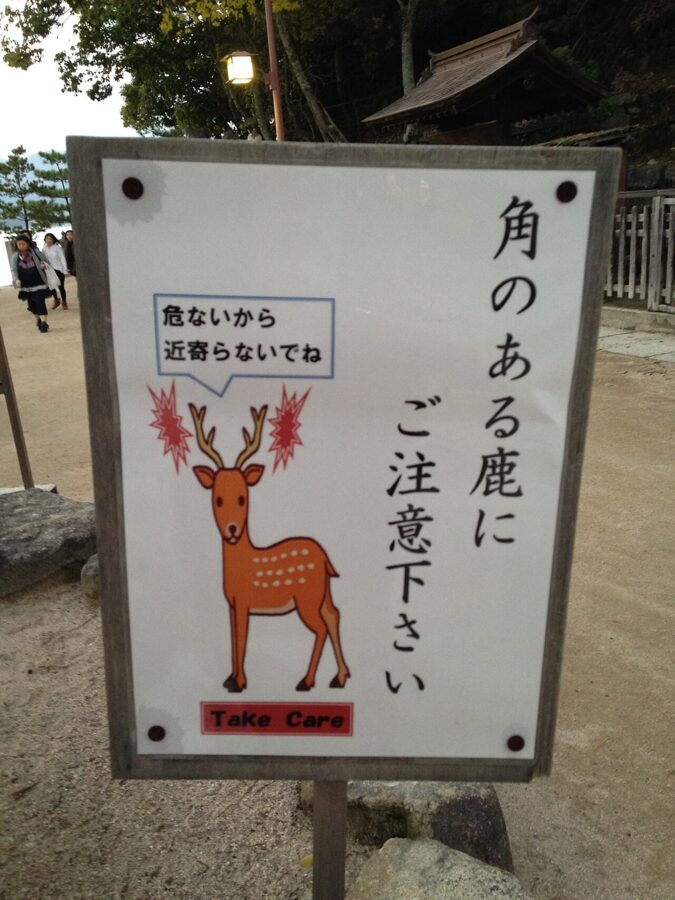
Learners who spent months in desu/masu often find the plain forms a shock, because suddenly 食べない, 食べた and 食べなかった all have to come quickly. The plain forms are worth the effort. They are the casual speech of every friend, drama and manga, and they are the forms that sit before nouns, as in the deer sign’s 角のある鹿, “deer that have antlers.”

Verbs before nouns
Japanese puts the describing clause before the noun, with no word for “who”, “which” or “that”. 昨日見た映画 (kinō mita eiga) is “the film I saw yesterday”, literally “yesterday saw film.” English speakers wait for a “that” that never comes. Practise by building one up from a short sentence: 映画を見た, then 昨日見た映画.

Giving and receiving
あげる (ageru), くれる (kureru) and もらう (morau) all mean some version of “give” or “receive”, and which one you use depends on whose side the speaker is on. くれる is for giving toward the speaker’s side: 友だちが本をくれました (tomodachi ga hon o kuremashita, polite), “A friend gave me a book.” It is an N4 topic that feels strange for weeks and then suddenly obvious.

Go back to the caterpillar sign from Kyoto and read it again: 木に毛虫がいます。ご注意ください!! You know the place particle, the subject particle, the existence verb and the polite request now. Copy it out by hand tonight, then write one sentence of your own on the same frame, something like 机に猫がいます, “There’s a cat on the desk.”