
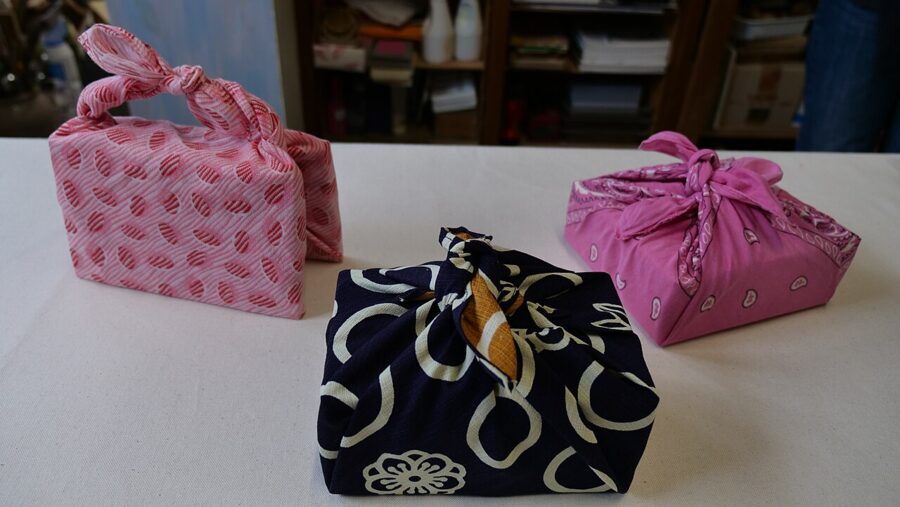
Two knots. That is all it takes to turn a 70-centimeter square of cloth into a lunch bag, a wine carrier or a gift wrap that you fold up and take home again afterward. The cloth is a furoshiki, and once your hands learn one knot, they can carry almost anything.

You do not need a special cloth to start. A large cotton scarf will do for the knot.

目次 Contents
- The word: 風呂敷, a bath spread
- Sizes, fabrics and the one to buy first
- Words you need while you wrap
- The square knot (ma-musubi), and how to untie it
- Six wraps, step by step
- Furoshiki today: a minister's cloth, a plastic bag fee and your lunch
- Where to buy a furoshiki in Japan, and what a good one costs
The word: 風呂敷, a bath spread
風呂敷 (ふろしき, furoshiki) is three kanji: 風呂 (furo) “bath” and 敷 (shiki), from the verb 敷く (shiku) “to spread out flat.” So the name means “bath spread,” an odd name for a cloth that mostly carries lunch, and a clue to where it comes from.
Wrapping cloths are far older than the word. Treasures in the Shōsōin storehouse in Nara were kept in fitted cloth wrappers in the eighth century, and in the Heian period the cloth was called 平包み (hirazutsumi, “flat wrap”).
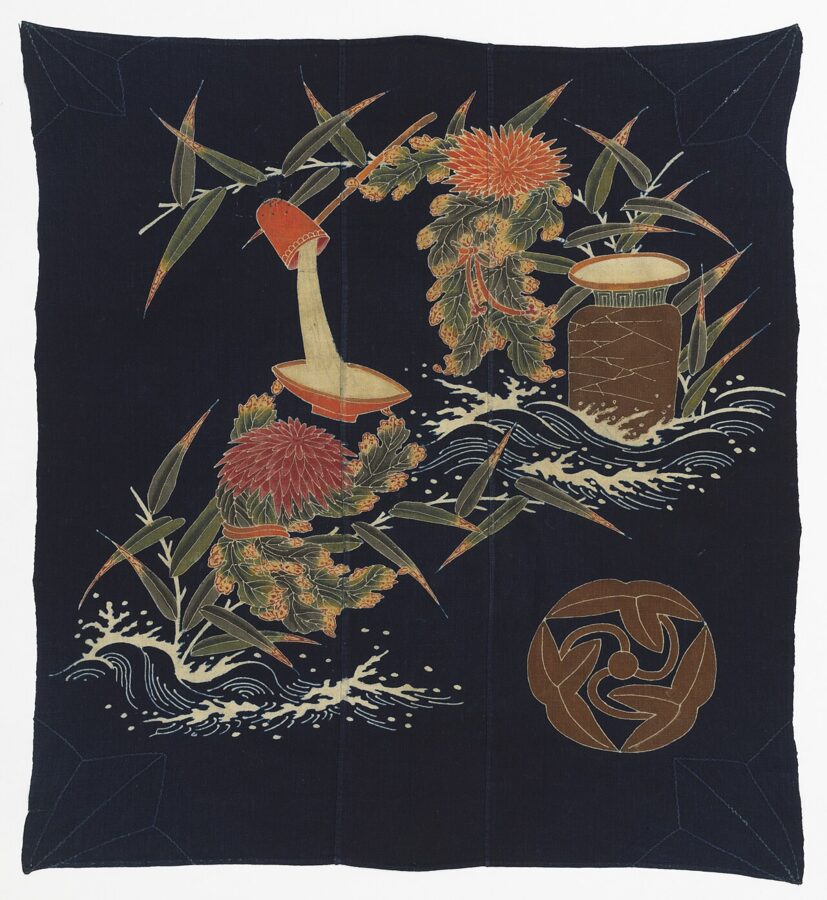
The “bath” part arrives in the Muromachi period (1336 to 1573). Kyoto’s furoshiki makers tell it like this: lords invited to bathe at the Ashikaga shoguns’ bathhouse wrapped their clothes in silk cloths dyed with their family crests, so nobody went home in the wrong kimono, then stood on the cloth to dress. Baths then were steam rooms with cloths spread on the floor, which fits the “spread.”
The word first appears in writing in 1616, in the inventory of Tokugawa Ieyasu’s belongings, as a “kokura cotton furoshiki” that was probably a bath mat. The Nihon Kokugo Daijiten, Japan’s largest dictionary, notes that hirazutsumi and furoshiki lived side by side until the Hōreki era (1751 to 1764), when the bath word won.
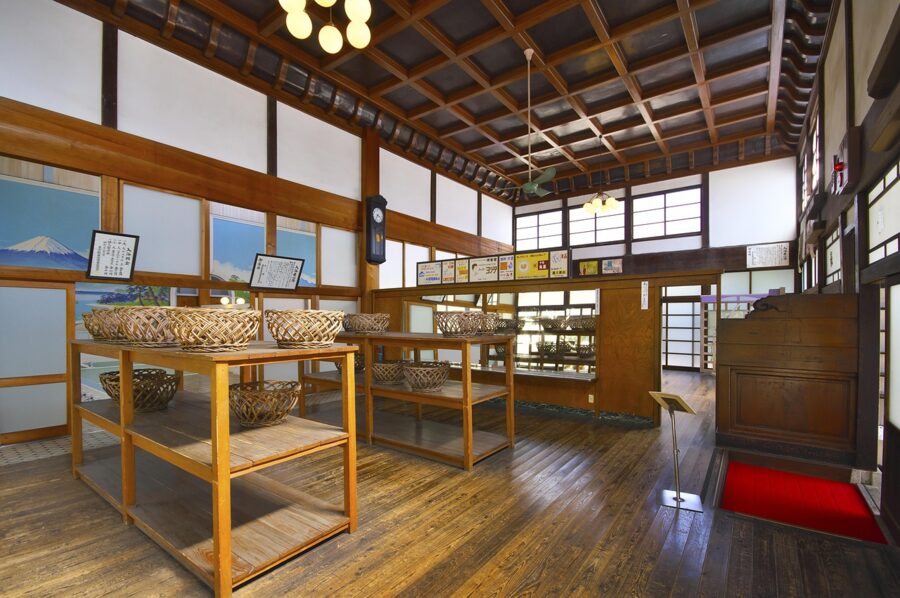
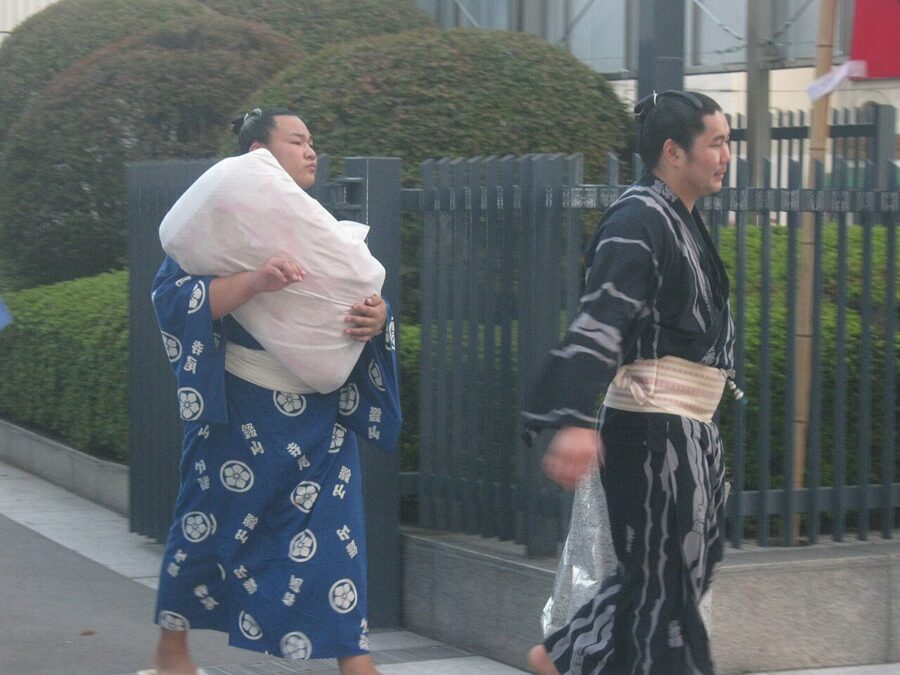
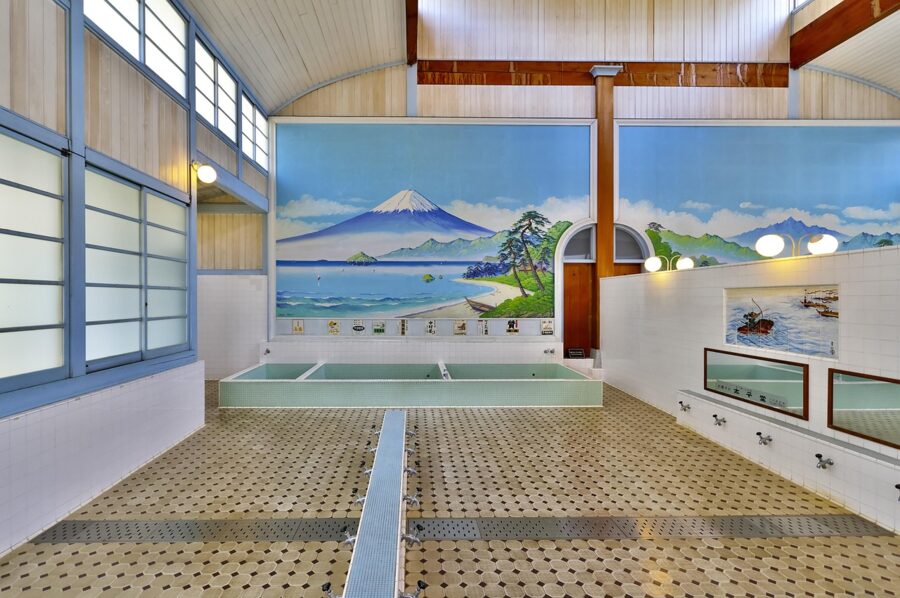
Public bathhouses, 銭湯 (sentō), spread through Edo after the first one opened in 1591, and people walked to them with towels and a yukata tied up in a square of cloth. From there the cloth went everywhere: the Edo store of the kimono merchant Daimaru bought in 14,500 furoshiki in 1750 and 60,670 in 1828.
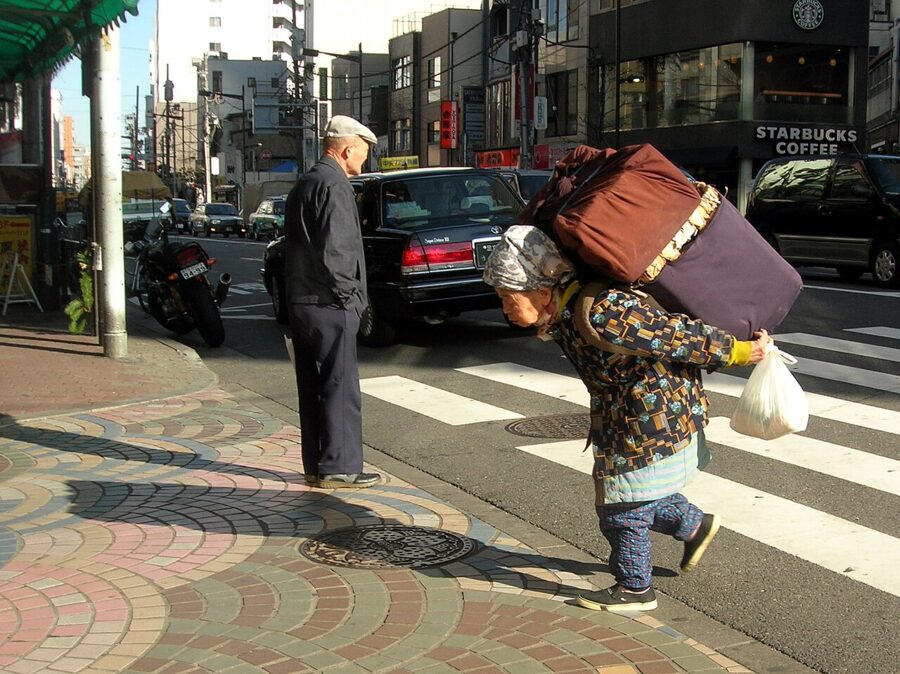
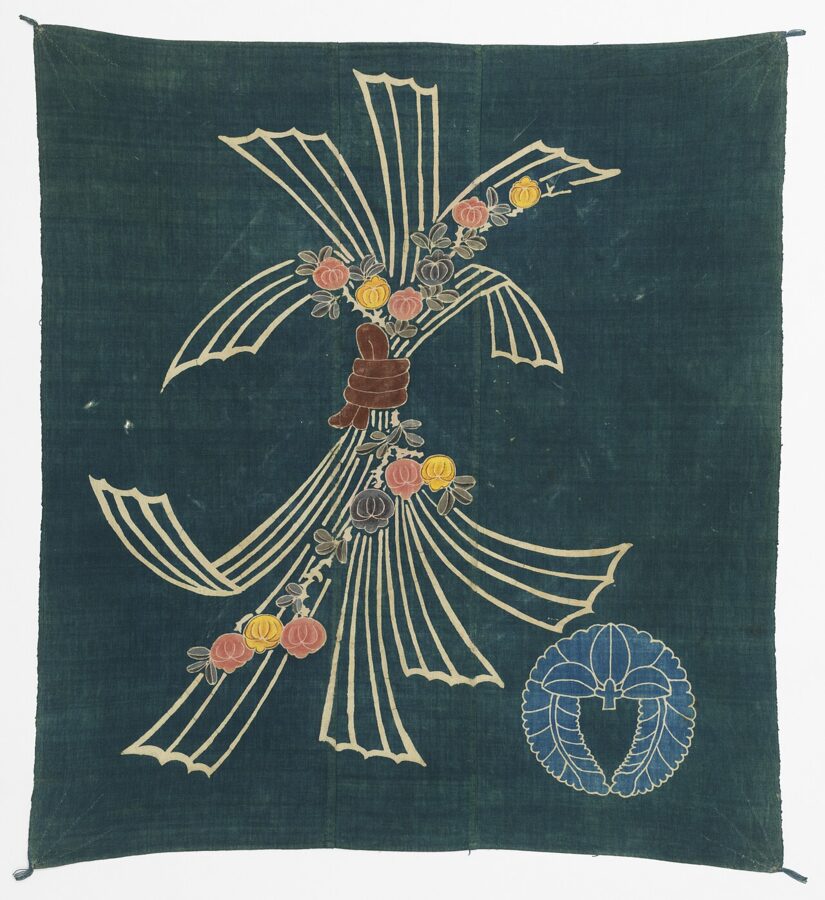
Peddlers walked Edo with their stock on their backs in huge cloths, and shop apprentices slept on a big furoshiki so they could bundle up the bedding when the fire bell rang. After 1875, when every commoner had to take a surname, new family crests went onto furoshiki, and the crested cloth became a standard gift.

Two bonus phrases come out of all this. 大風呂敷を広げる (ōburoshiki o hirogeru), “to spread out a big furoshiki,” means to talk big. And Meiji-era Tokyo children playing rock, paper, scissors called the open hand “furoshiki” instead of paper.
Sizes, fabrics and the one to buy first
Furoshiki sizes are counted in 幅 (haba), an old width of cloth. One haba was about 34 centimeters in the Edo period, and big cloths were sewn from several widths. The names stuck, and Kyoto makers list these standard sizes:
| Name | About | Good for |
|---|---|---|
| 中幅 chūhaba | 45 cm | Money envelopes, a small lunch box, tissue box |
| 一尺三寸幅 isshaku sanzun haba | 50 cm | Lunch boxes, tissue box cover |
| 二幅 futahaba | 68 to 70 cm | The everyday size: boxed sweets, one wine bottle, a bag |
| 二四幅 nishi haba | 90 cm | Shopping bag, two bottles, a 1.8-liter sake bottle |
| 三幅 mihaba | 105 cm | Shopping bag, tablecloth |
| 七幅 nanahaba | 238 cm | Two futon sets |
Is a furoshiki always square? Almost, but not quite. Makers cut traditional cloths 2 to 3 percent longer than they are wide, which gives a little more stretch around a box, though some modern ones are square.
Fabric decides how a knot behaves. Cotton grips and forgives mistakes, so learn on cotton. Silk crepe, 縮緬 (chirimen), is the formal gift choice, and polyester is cheap and shrugs off rain, but its knots can creep loose under weight.
A 手ぬぐい (tenugui) is a different thing: a thin cotton towel, roughly 35 by 90 centimeters with raw ends, for hands and sweat. A furoshiki is square, hemmed and made for wrapping. For a first one, I would buy a 70-centimeter cotton cloth, which handles every wrap below.
Words you need while you wrap
These are verbs you meet early when learning Japanese. Notice that 包む and 包み are one word as verb and noun, and 結ぶ and 結び work the same way.
| Japanese | Romaji | English |
|---|---|---|
| 包む(つつむ) | tsutsumu | to wrap |
| 包み(つつみ) | tsutsumi | a wrapped bundle; a way of wrapping |
| 結ぶ(むすぶ) | musubu | to tie |
| 結び(むすび) | musubi | a knot; a way of tying |
| 解く(ほどく) | hodoku | to untie |
| 広げる(ひろげる) | hirogeru | to spread out, open up |
| 真結び(まむすび) | ma-musubi | square knot, the main furoshiki knot |
| 縦結び(たてむすび) | tate-musubi | granny knot, the mistake to avoid |
| ひとつ結び | hitotsu-musubi | single overhand knot in one corner |
And in sentences:
| Japanese | Romaji | English | Level |
|---|---|---|---|
| ふろしきで包みましょうか。 | Furoshiki de tsutsumimashō ka. | Shall I wrap it in a furoshiki? | polite |
| 端と端を結んでください。 | Hashi to hashi o musunde kudasai. | Please tie the two ends together. | polite |
| かたく結びすぎちゃった。 | Kataku musubisugichatta. | I tied it way too tight. | casual |
One piece of wordplay to remember them by: February 23 is marked as つつみの日 (tsutsumi no hi), “wrapping day,” because 2, 2, 3 can be read tsu, tsu, mi. One Kyoto maker times its yearly sale to it.
The square knot (ma-musubi), and how to untie it
Almost every wrap ends in 真結び (ma-musubi), the square knot. It holds under weight and comes undone in a second if you know the trick. The rule: right over left, then left over right.
- Hold one corner of the cloth in each hand.
- Cross the right end over the left end, tuck it under, and pull. The ends have now swapped hands.
- Cross the end now in your left hand over the end in your right hand, tuck it under and up through the hole in the middle.
- Pull both ends at once, sideways, until the knot sits snug.
Check it. In a real ma-musubi the two tails lie flat and point sideways. If they stick up and down, you have a 縦結び (tate-musubi), the granny knot, and 縦 (tate) means vertical. It slips, so redo the second crossing left over right.
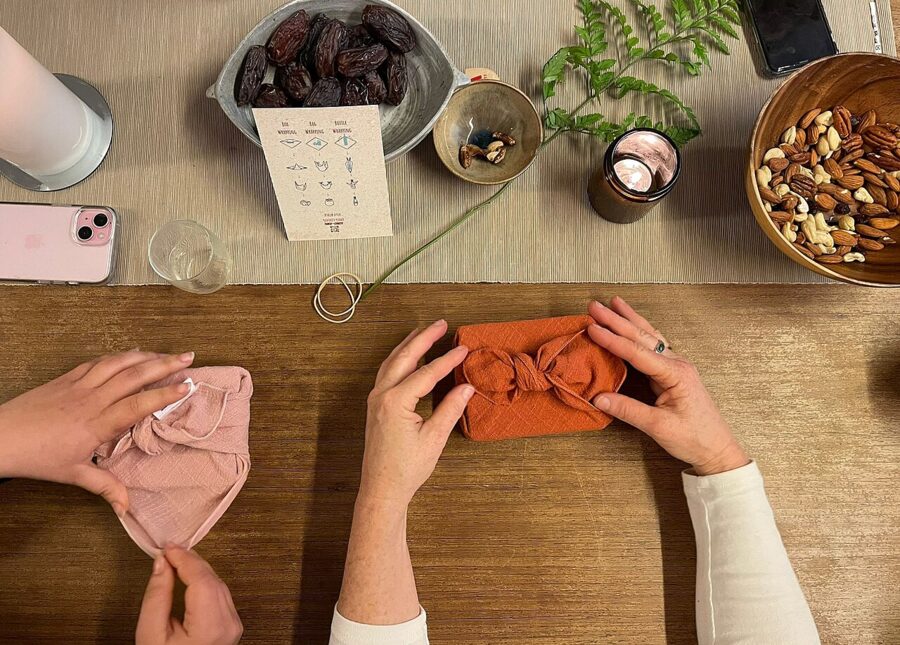

To untie a tight ma-musubi:
- Take one tail in your right hand.
- Pull it out straight until that strand is one line. The knot flips into a loose loop around it.
- Hold the loop lightly and slide it off the straight strand.
The second knot is ひとつ結び (hitotsu-musubi), a plain overhand knot in one corner, used to close the bottom of a bag.
Six wraps, step by step
Every wrap starts the same way: cloth pattern side down, turned into a diamond with one corner pointing at you, object in the center. The corners are near, far, left and right.
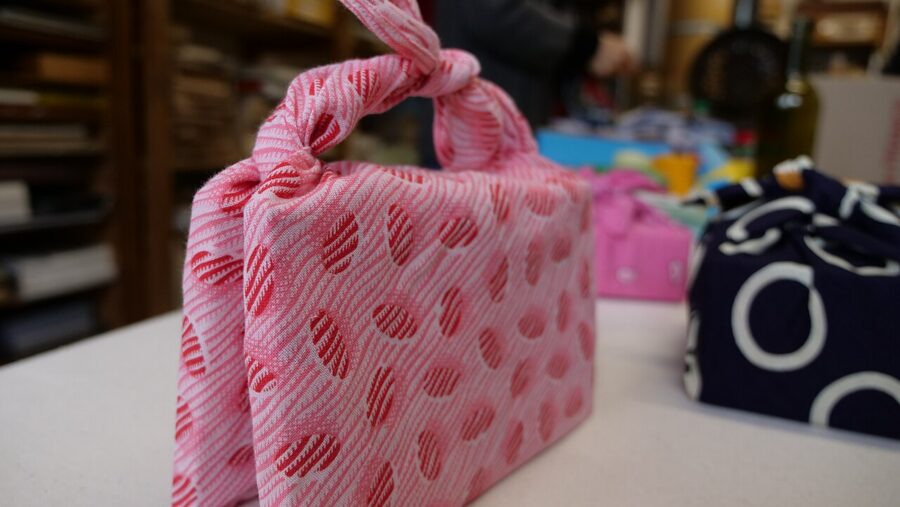
1. Otsukai-tsutsumi (お使い包み): the everyday carry
お使い (otsukai) is an errand, and this is the errand wrap, also called the lunch box wrap.
- Fold the near corner over the box and tuck its tip under the far edge of the box.
- Fold the far corner over the top of the box toward you.
- Lift the left and right corners straight up over the box.
- Tie them together on top in a ma-musubi, close to the box so the wrap is tight.
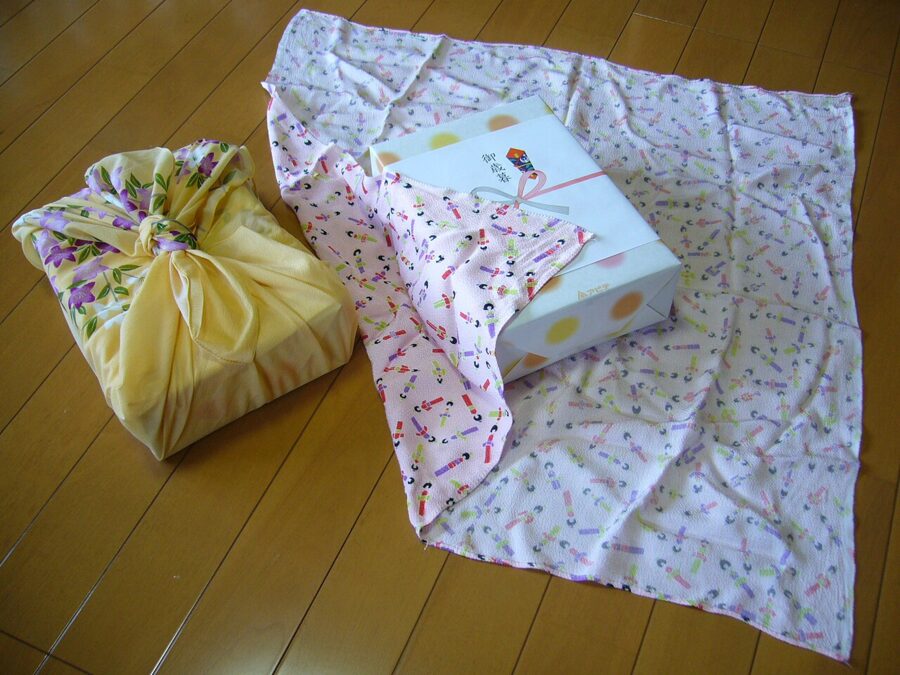

If the knot sits off center, so was the box: shift it toward the short corner and retie.

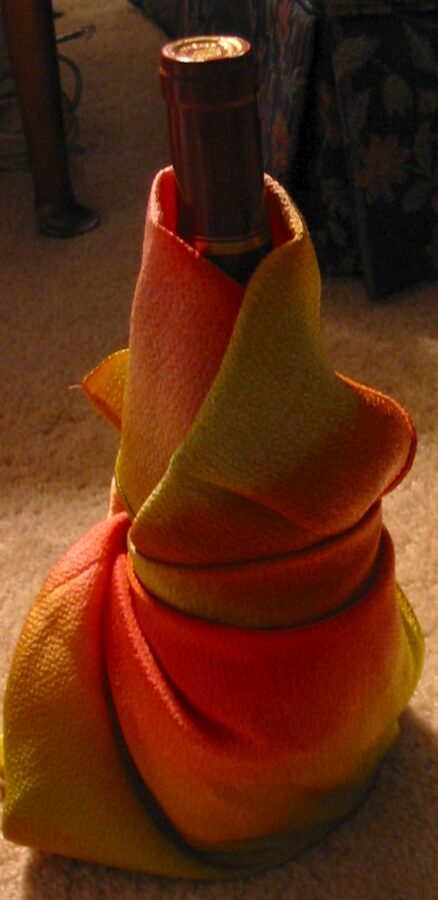
2. Bin-tsutsumi (瓶包み): one bottle with a handle
瓶 (bin) is a bottle. A 70-centimeter cloth fits a wine bottle; for a 1.8-liter 一升瓶 (isshōbin) of sake, use a 90-centimeter one.
- Stand the bottle in the center of the cloth.
- Bring the near and far corners up and tie them in a ma-musubi just above the bottle’s mouth.
- Lift the left and right corners, smooth them against the bottle, and take them around to the back.
- Cross them behind the bottle, bring them back to the front, and tie them in a ma-musubi. Laying the bottle on its side for this step keeps it steady.
- Stand the bottle up. Undo the knot over the mouth, twist each of its two ends in opposite directions, and tie the tips together in a ma-musubi to make a handle loop.
3. Two bottles side by side
Kyoto makers call this 合わせ包み (awase-tsutsumi), the “joined wrap,” and it is my favorite. The cloth rolls between the bottles, so they never clink together. Use two bottles of the same shape; a 70-centimeter cloth does two wine bottles, and sake bottles need 90 centimeters or more.
- Lay the bottles on their sides across the middle, bottoms facing each other 2 or 3 centimeters apart, necks pointing at the left and right corners.
- Fold the near corner over both bottles.
- Holding the bottles parallel, roll them away from you all the way up the cloth.
- Finish with the far corner’s tip sitting over the gap.
- Stand both bottles up at once so their bottoms pinch that tip underneath.
- Bring the left and right corners up over the necks and tie them in a firm ma-musubi. That knot is your handle.
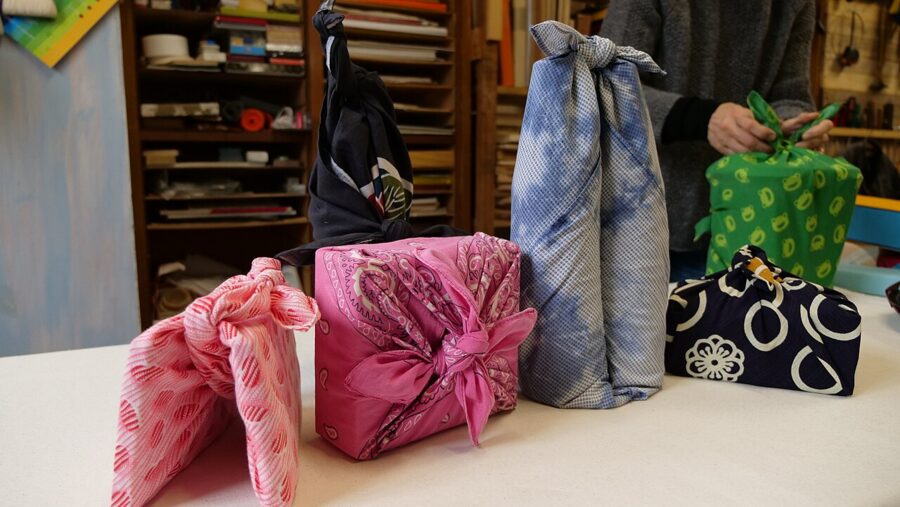

4. The book wrap
本 (hon) is a book, and this wrap carries two like a briefcase: a textbook and its workbook, say.
- Lay the two books side by side across the center of the cloth, with a gap of about two finger widths between them.
- Fold the near corner up over both books.
- Fold the far corner down over both books.
- Pick the books up together and fold them toward each other at the gap, so they stand back to back like a closed book.
- Bring the left and right corners up over the top and tie them in a ma-musubi. Tie it loose for a handle.
For one long box, try ふたつ結び (futatsu-musubi): lay it from left corner to right corner, tie near to left and far to right, and untie either knot to slide it out.
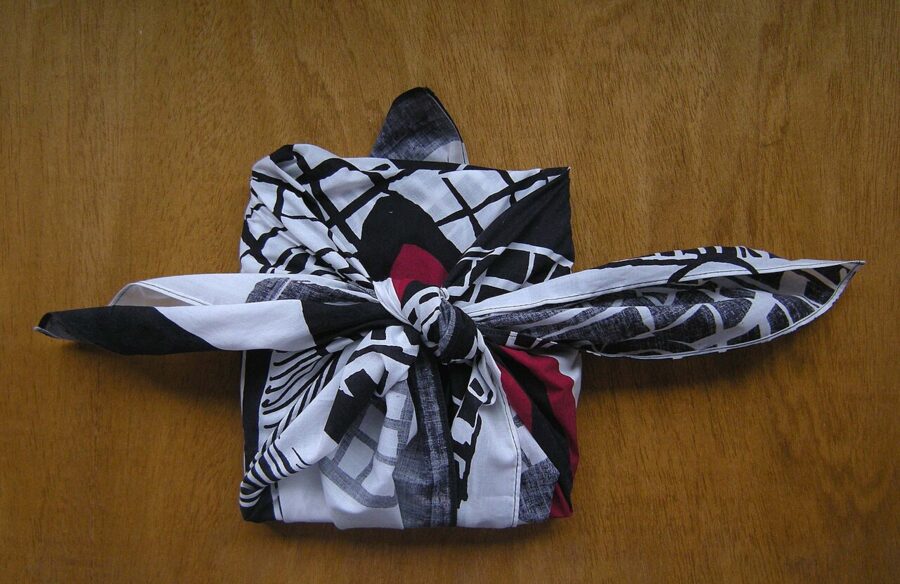

5. Shizuku bag (しずくバッグ): the drop bag
しずく (shizuku) is a drop of water, and the bag hangs in that shape. Use a 70-centimeter cloth.
- Lay the cloth pattern side down and fold it in half corner to corner into a triangle, long side toward you.
- Tie a hitotsu-musubi in each of the two bottom corners. Use about a quarter of the bottom edge for each knot.
- Check that both sides are the same length.
- Turn the whole thing inside out, so the pattern is outside and the two knots disappear inside.
- Tie the two top corners together in a ma-musubi. That loop is the handle, and the opening sits right below it.
For a bag that closes, tie one deep single knot in the top corners first, then the ma-musubi above it.
6. Gift wraps: the flower and the formal flat wrap
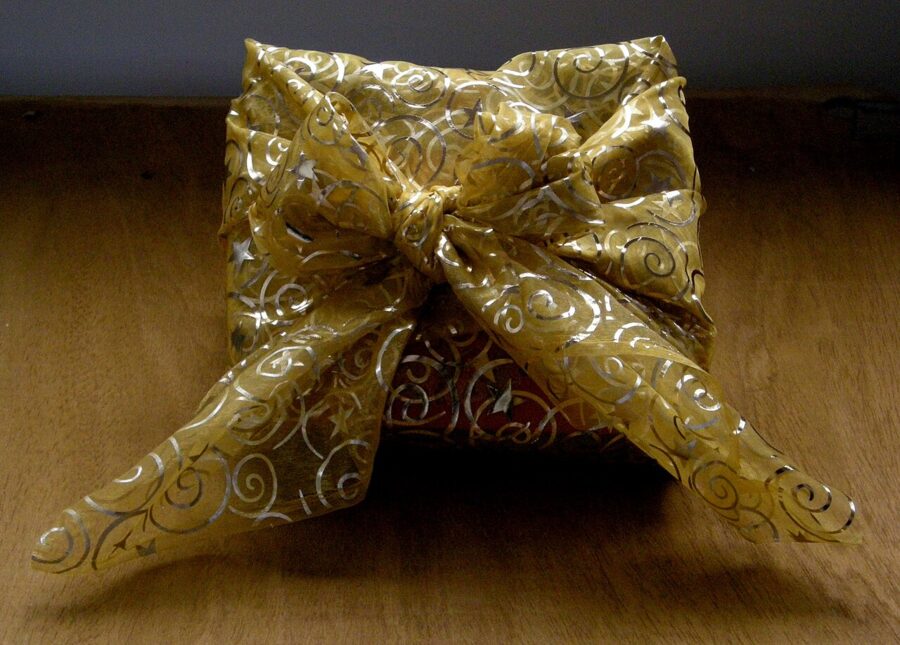
For a present, learn 花包み (hana-tsutsumi), the flower wrap, which works on boxes and round tins.
- Lay the cloth as a diamond and set the gift in the middle.
- Gather the near and far corners together above the gift and grip them at the base with one hand.
- Take the left and right corners around behind your hand, cross them there, and bring them back to the front.
- Wrap them around the gathered base and tie a ma-musubi in front.
- Pinch the near and far corners 5 centimeters from their tips and tuck each pinch into the center of the knot. The cloth around them opens like petals.

The most formal wrap has no knot. 平包み (hira-tsutsumi), the flat wrap, folds the four corners over the box in turn and tucks the last under. Its order flips with the occasion: 右包み (migi-tsutsumi), the right wrap, for celebrations, and 左包み (hidari-tsutsumi), the left wrap, for funerals and condolence money. Kyoto makers trace this to an order of 719 that kimono close right side under left, which left the reverse for dressing the dead.
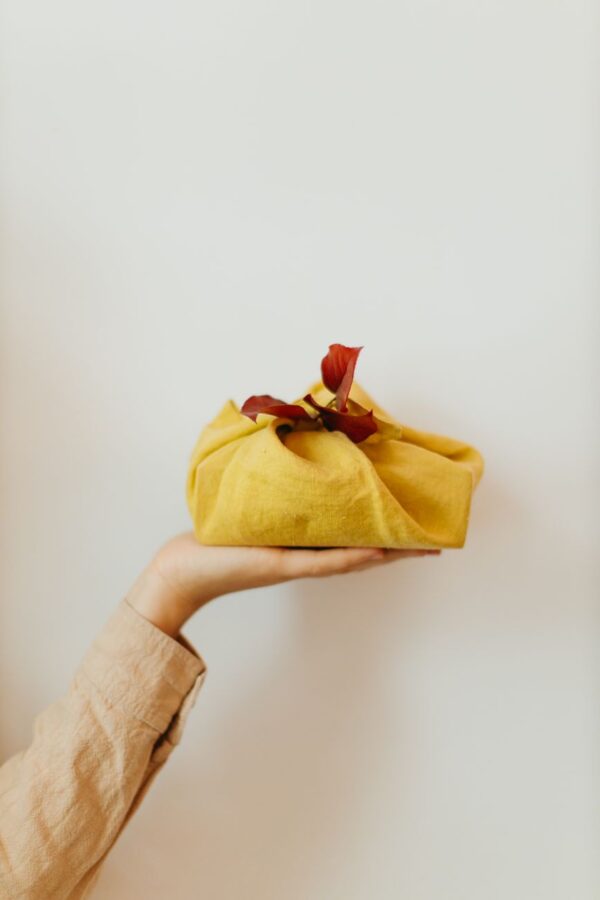
One custom: you carry a gift to someone’s home in the furoshiki, take it out before you hand it over, and fold the cloth to take home.
Furoshiki today: a minister’s cloth, a plastic bag fee and your lunch
On December 22, 2005, Environment Minister Yuriko Koike announced in the cabinet’s email newsletter that she had made a “mottainai furoshiki.” もったいない (mottainai) means “what a waste,” and the cloth was made from recycled plastic bottles and printed with paintings by the Kyoto artist Itō Jakuchū. Her case: plastic shopping bags made about 600,000 tonnes of trash a year.
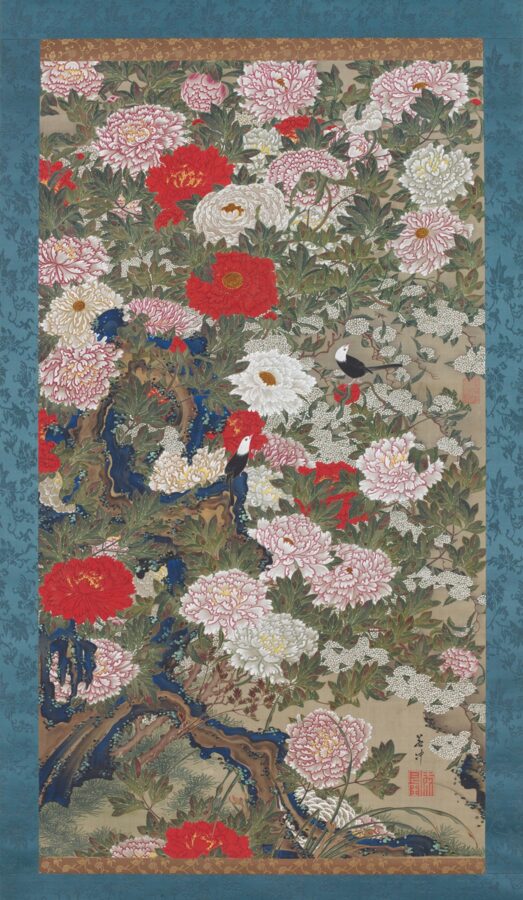
The Ministry of the Environment kept at it through 2006. On January 22 the minister handed the cloths to Japan’s team for the Turin Winter Olympics, the soccer team got them before the World Cup, and ministry staff ran wrapping classes for themselves.
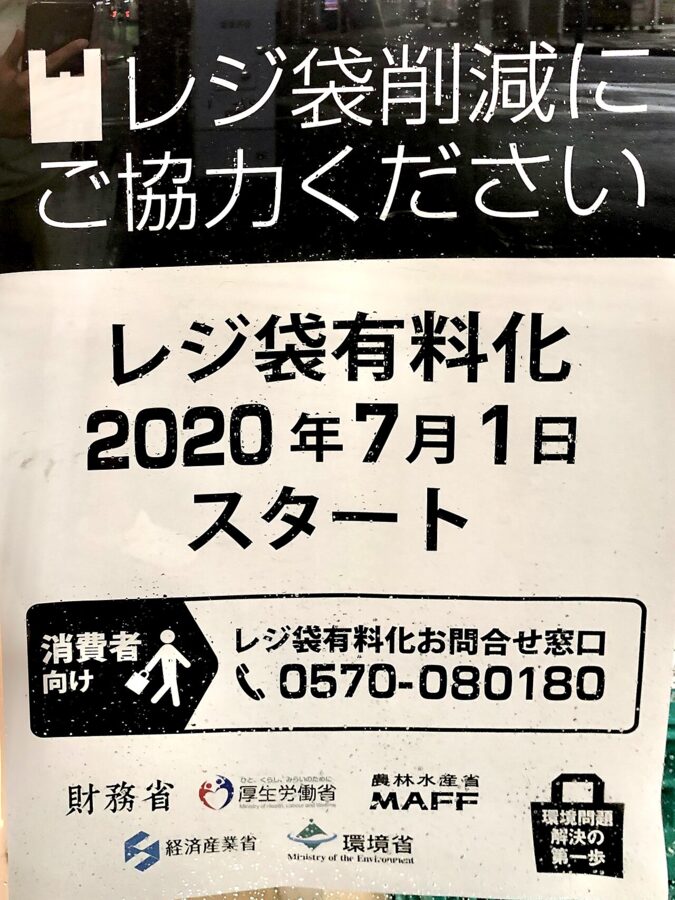

The bigger push came in 2020, when shops across Japan began charging for plastic bags, and makers now sell water-repellent cloths in 100-centimeter “eco bag” sizes. At the konbini till you will hear 袋はご利用ですか (fukuro wa go-riyō desu ka, polite), “Will you use a bag?”, and いいえ、大丈夫です (iie, daijōbu desu) is your polite “No, I’m fine.”
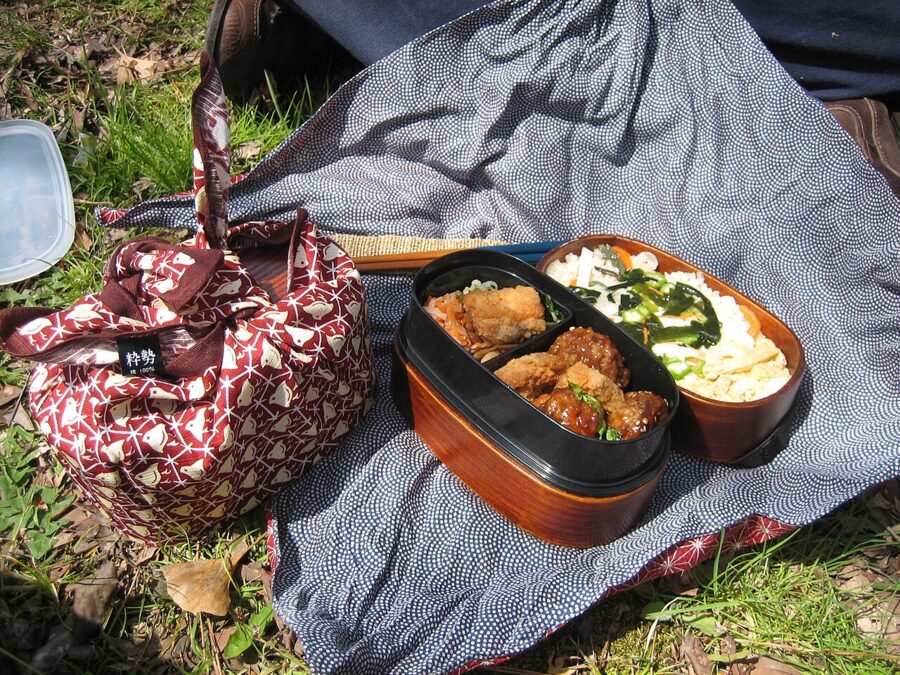

Everyday use never stopped: children carry their 弁当 (bentō) to school tied otsukai-style. Gift-giving is the corner of Japanese culture where the cloth never went away: presents still travel in furoshiki to formal visits, weddings and funerals.
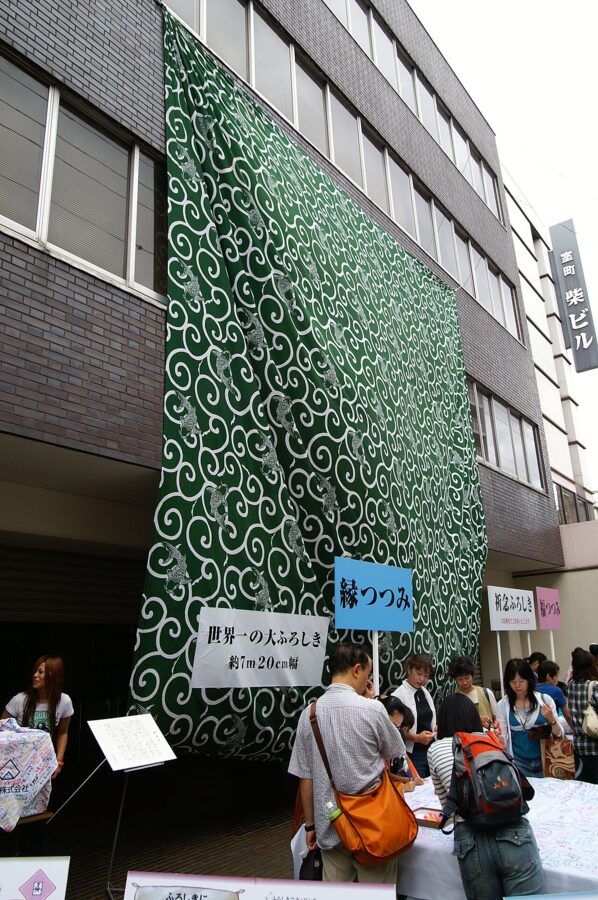

Where to buy a furoshiki in Japan, and what a good one costs
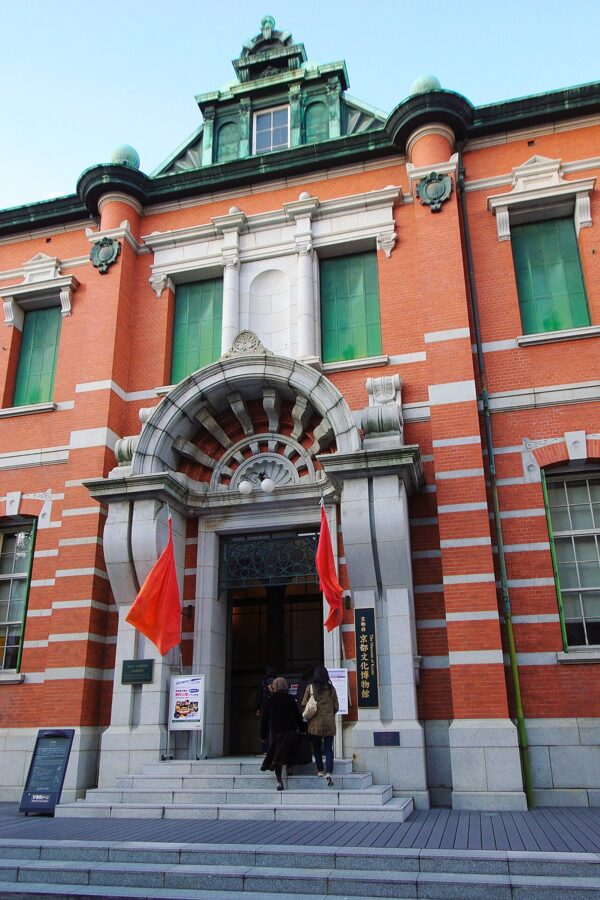
Department stores and souvenir shops sell furoshiki, but for the full range I would go to a maker’s own shop: むす美 (musubi), run by the Kyoto maker Yamada Sen-i, with one branch in each city.
musubi Kyoto is on Sanjō-dōri just east of Sakaimachi-dōri in Nakagyō-ku, on the south side of the street next to Inoda Coffee’s Sanjō branch. From exit 5 of Karasuma Oike subway station, walk east along Sanjō. As of November 2026 it opens 11:00 to 19:00 every day except summer and New Year breaks.

musubi Tokyo is at 2-31-8 Jingūmae, Shibuya, a 7-minute walk from exit 5 of Meiji-jingumae Station or 9 minutes from the Takeshita exit of JR Harajuku Station. As of November 2026 it opens 11:00 to 19:00 and closes on Wednesdays.

Wrapping workshops, in the shop or online, cost ¥2,200 (about $14) since April 2026, and Kyoto adds a 30-minute taster. Around tsutsumi no hi both shops hold a “MOTTAINAI” sale of seconds; in 2026 it ran February 21 to 23.
Prices from the maker’s online shop, tax included, as of November 2026:
| What you get | Size | Price |
|---|---|---|
| Plain polyester crepe, many colors | 70 cm | ¥660 (about $4) |
| Plain organic cotton | 48 cm | ¥605 (about $4) |
| Organic cotton printed with an ukiyo-e scene | 70 cm | ¥1,650 (about $11) |
| Water-repellent “Aqua Drop” print | 70 cm | ¥2,200 (about $14) |
| Reversible cotton, two colors | 100 cm | ¥4,400 (about $28) |
| Water-repellent eco bag size | 100 cm | ¥3,850 to ¥5,830 (about $25 to $37) |
| Plain silk crepe (chirimen) | about 45 cm | ¥4,950 (about $32) |
| Silk crepe in a wooden gift box | about 68 cm | ¥18,700 (about $119) |
| Hand-dyed natural indigo cotton | 100 cm | ¥38,500 to ¥41,800 (about $245 to $266) |
So what does a good one cost? ¥1,500 to ¥2,500 (about $10 to $16) buys a 70-centimeter cotton or water-repellent furoshiki that will last for years. Polyester is fine for gift wrapping, and silk is for formal gifts, not groceries.
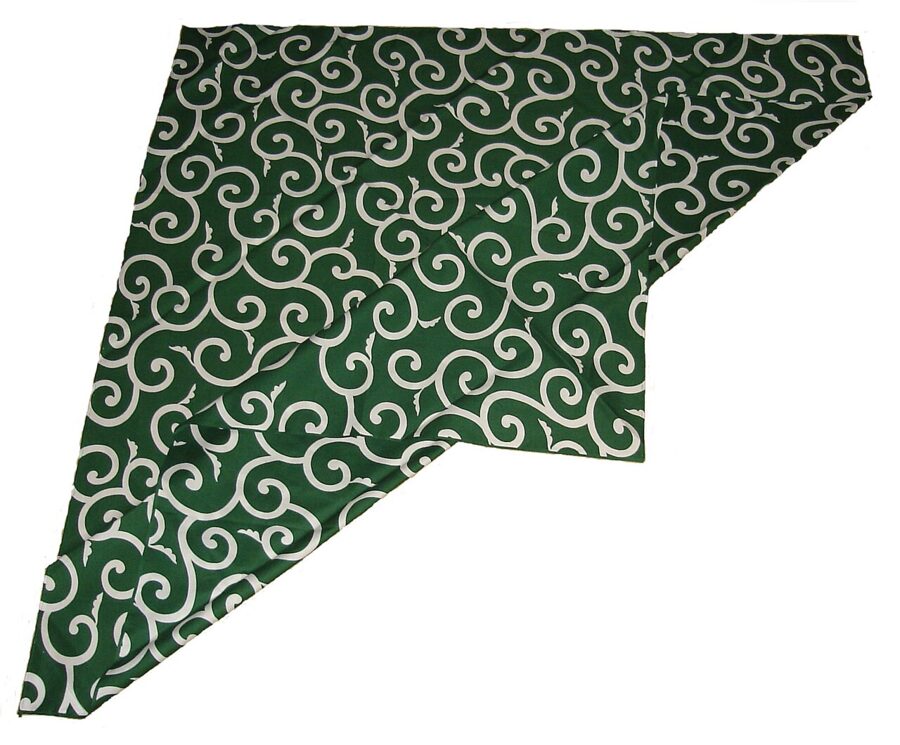
The other big Kyoto maker, Miyai, founded in 1897, sells online as Karakusaya. Wherever you buy, unfold the cloth first and look for even hems and a corner that knots without sliding.
Two knots, back at the start. Tonight, take any scarf, tie one ma-musubi, check that the tails point sideways, then slide it apart with the straight-pull trick. Do it five times and tomorrow’s lunch box is ready for its first otsukai-tsutsumi.