
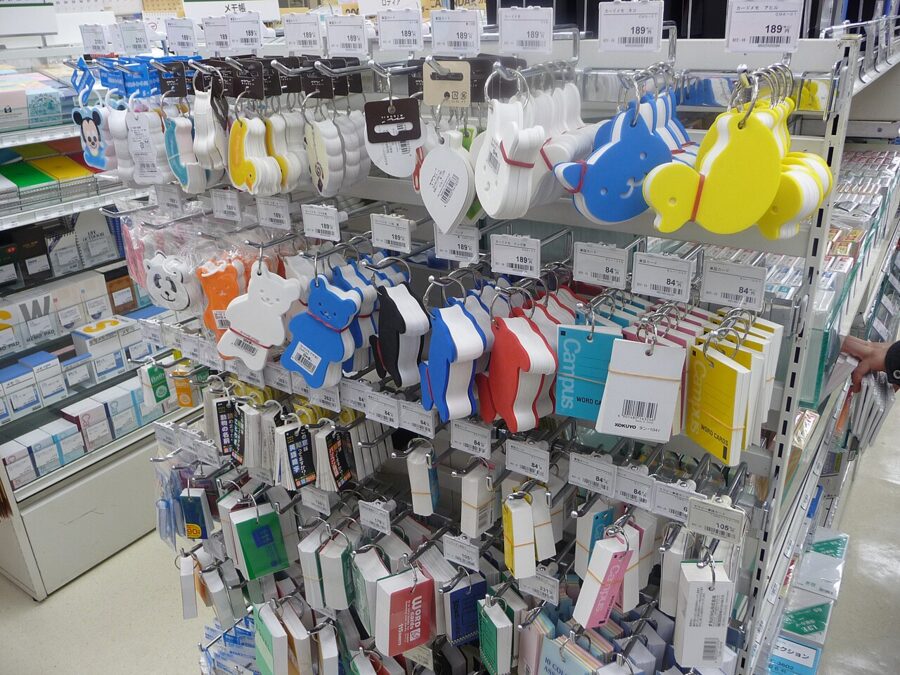
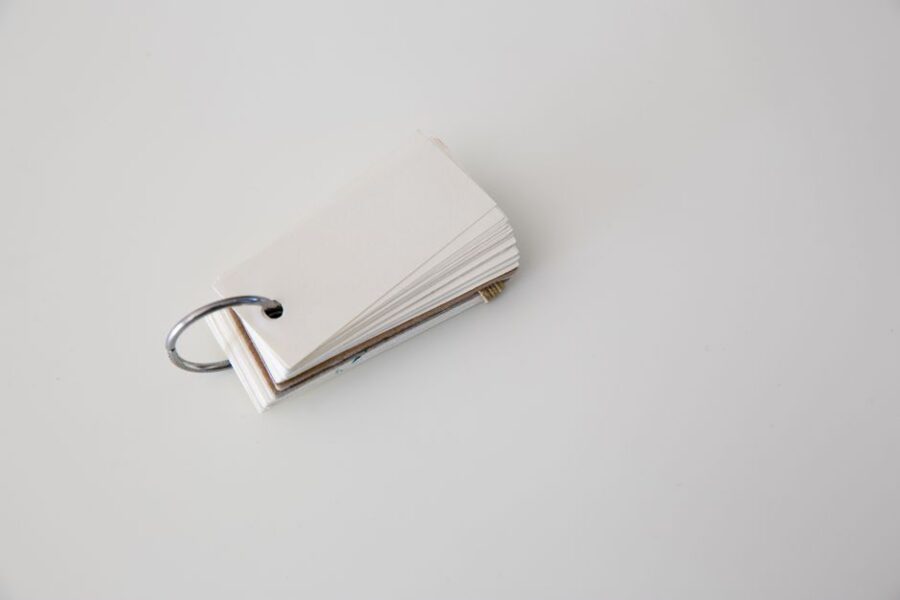
A ring of 85 blank word cards costs ¥155 (about $1) before tax in Japan, and it is still one of the best vocabulary tools you can own. Japanese high schoolers flip through them on trains to cram English. You can turn the same cards around and use them for Japanese.
The ring is the easy part, though. What goes on the cards matters more: which words come first, how you write them, and when you look at them again. This lesson gives you around a hundred starter words in groups you’ll actually meet, then the drilling method that makes them stay.
How many words does Japanese have? The largest Japanese dictionary, the Nihon Kokugo Daijiten, lists about 503,000 entries. You need a tiny fraction of that. The JLPT doesn’t publish an official word list for any level, but teachers and learners commonly put the beginner N5 level at around 800 words.
So start smaller than that. A hundred well-chosen words, learned with sound and kana, will carry you through a station, a supermarket and a first conversation about the weather. The rest of the Japanese language builds on exactly these.

One condition before any of this works: read hiragana first. If you still sound out each kana, spend a week or two on the 46 basic characters, then come back. Cards in romaji feel faster on day one and slower every day after.
目次 Contents
The first hundred words, in the groups you’ll meet them
Learn words in small families, not as a random list. Hot sits better next to cold, and train next to station, because each word gives the other a hook. Every table below reads kana first (with the usual kanji in brackets), then romaji, then English.
Food and drink
| Japanese | Romaji | English |
|---|---|---|
| ごはん (ご飯) | gohan | cooked rice; a meal |
| みず (水) | mizu | water |
| おちゃ (お茶) | ocha | tea (usually green) |
| コーヒー | kōhī | coffee |
| ぎゅうにゅう (牛乳) | gyūnyū | milk |
| パン | pan | bread |
| たまご (卵) | tamago | egg |
| にく (肉) | niku | meat |
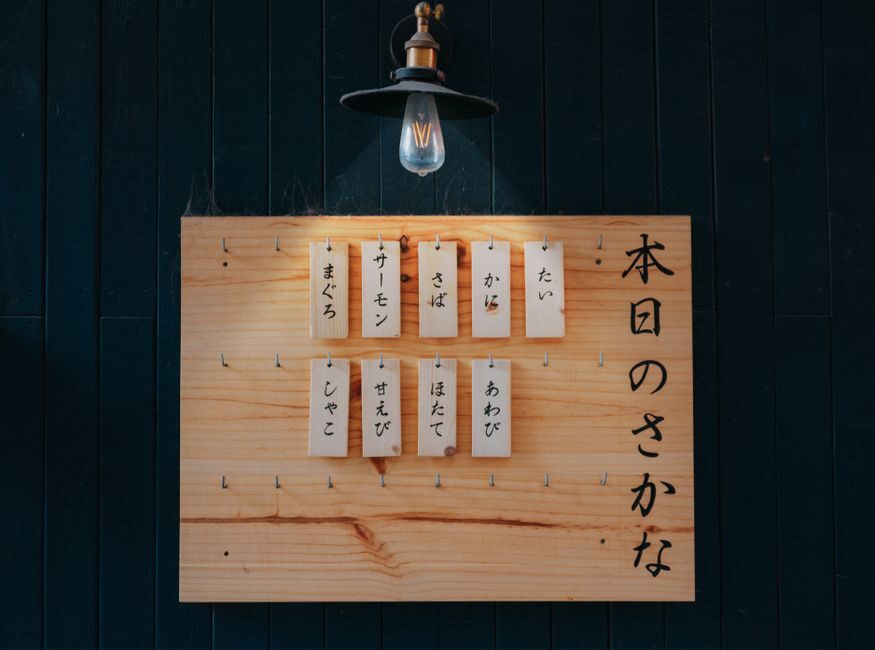
| さかな (魚) | sakana | fish |
| やさい (野菜) | yasai | vegetables |
| くだもの (果物) | kudamono | fruit |
| あさごはん (朝ご飯) | asagohan | breakfast |
Notice ごはん. It means cooked rice, but it also means a meal, so あさごはん is “morning rice”, breakfast. Once you know that, ひるごはん (lunch) and ばんごはん (dinner) cost you almost nothing to learn.
Your first useful sentence uses one of these words: お水をください (omizu o kudasai), “Water, please.” It’s polite, and it works in every restaurant in the country. Dishes, menus and how to order are a bigger subject, covered in Japanese food.

Time and the calendar
| Japanese | Romaji | English |
|---|---|---|
| いま (今) | ima | now |
| きょう (今日) | kyō | today |
| あした (明日) | ashita | tomorrow |
| きのう (昨日) | kinō | yesterday |
| あさ (朝) | asa | morning |
| よる (夜) | yoru | night |
| まいにち (毎日) | mainichi | every day |
| しゅうまつ (週末) | shūmatsu | weekend |
| げつようび (月曜日) | getsuyōbi | Monday |
| にちようび (日曜日) | nichiyōbi | Sunday |
| 〜じ (〜時) | -ji | o’clock (さんじ, 3:00) |
| しがつ (四月) | shigatsu | April |
Months are the easy part: number plus がつ. いちがつ is January, にがつ February, and so on. Three of them bend, so give them a card each: しがつ (April, never よんがつ), しちがつ (July) and くがつ (September).
The days of the week hide a little set of nature words. 月 is moon, 火 fire, 水 water, 木 tree, 金 gold, 土 earth and 日 sun, so げつようび is literally “moon day”. Learn the seven day names and you’ve picked up seven kanji you’ll see on every calendar in Japan.
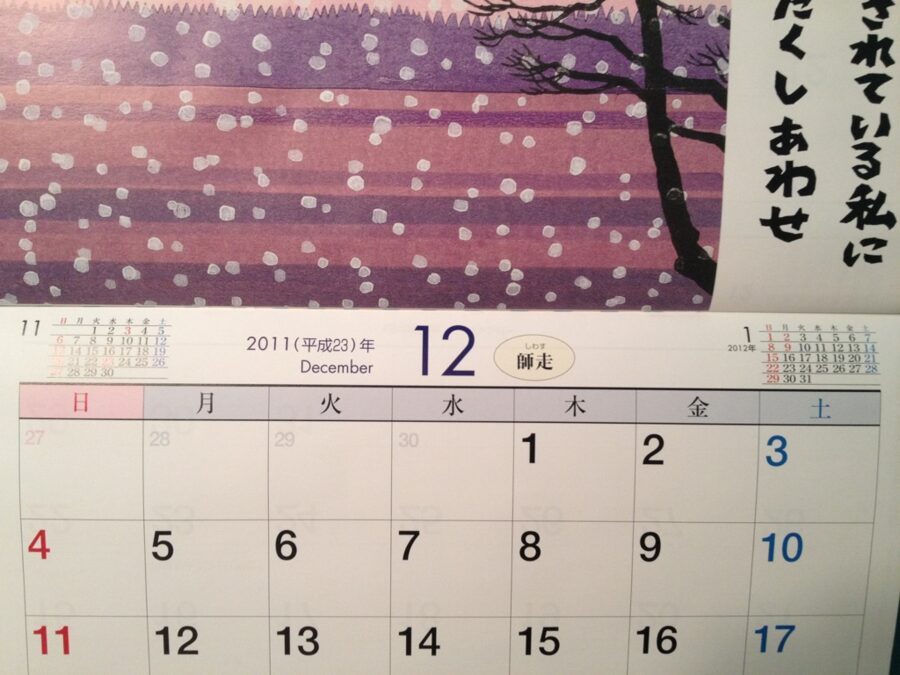

Old month names like 師走 belong to Japanese culture more than to daily speech. Leave them off your first deck.
Colors
| Japanese | Romaji | English |
|---|---|---|
| あか / あかい (赤 / 赤い) | aka / akai | red |
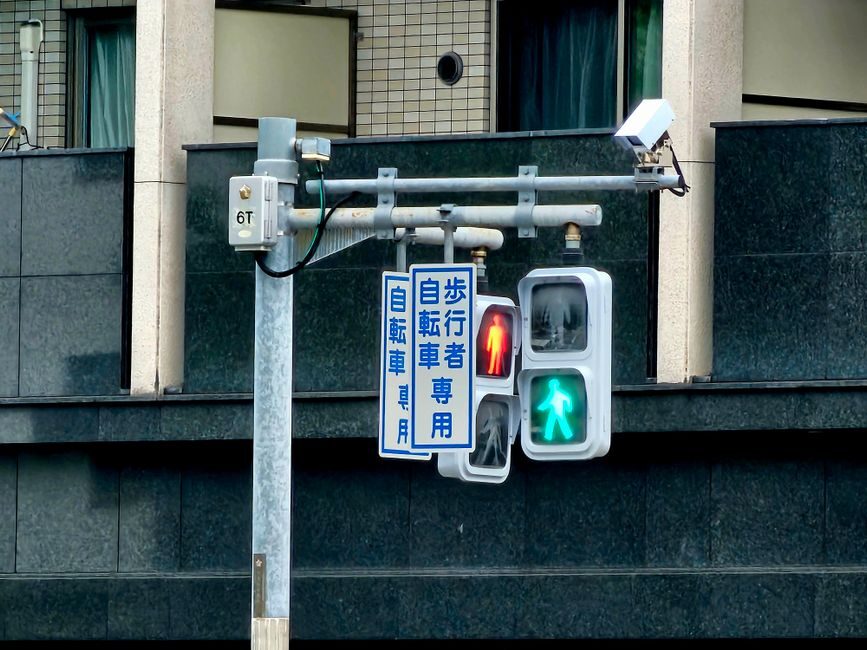
| あお / あおい (青 / 青い) | ao / aoi | blue (and the green of a go signal) |
| しろ / しろい (白 / 白い) | shiro / shiroi | white |
| くろ / くろい (黒 / 黒い) | kuro / kuroi | black |
| きいろ / きいろい (黄色 / 黄色い) | kiiro / kiiroi | yellow |
| ちゃいろ (茶色) | chairo | brown |
| みどり (緑) | midori | green |
| ピンク | pinku | pink |
Colors come in two shapes. The old ones have a noun (あか, red) and an adjective (あかい, red-colored), so あかいくるま is “a red car”. Newer ones like みどり have only the noun, and take の instead: みどりのかばん, “a green bag”.
The body
| Japanese | Romaji | English |
|---|---|---|
| あたま (頭) | atama | head |
| かお (顔) | kao | face |
| め (目) | me | eye |
| みみ (耳) | mimi | ear |
| はな (鼻) | hana | nose |
| くち (口) | kuchi | mouth |
| は (歯) | ha | tooth |
| て (手) | te | hand |
| あし (足) | ashi | foot; leg |
| おなか (お腹) | onaka | stomach |
Body words earn their place the day you feel unwell. あたまがいたいです (atama ga itai desu, polite) means “I have a headache”, and swapping in おなか gives you a stomachache. One pattern, ten complaints.
Watch はな, though. It is both nose (鼻) and flower (花), and the kana alone won’t tell you which. That’s one of the best arguments for putting audio on your cards, which comes up again below.
Animals
| Japanese | Romaji | English |
|---|---|---|
| いぬ (犬) | inu | dog |
| ねこ (猫) | neko | cat |
| とり (鳥) | tori | bird |
| うし (牛) | ushi | cow |
| ぶた (豚) | buta | pig |
| うま (馬) | uma | horse |
| さる (猿) | saru | monkey |
| しか (鹿) | shika | deer |
| くま (熊) | kuma | bear |
Animals pay off at the meat counter. Put 牛 in front of にく and you get ぎゅうにく (gyūniku), beef; 豚 gives ぶたにく (butaniku), pork; 鳥 gives とりにく (toriniku), chicken. Keep these three cards next to each other in your deck.

Getting around
| Japanese | Romaji | English |
|---|---|---|
| えき (駅) | eki | station |
| でんしゃ (電車) | densha | train |
| ちかてつ (地下鉄) | chikatetsu | subway |
| しんかんせん (新幹線) | shinkansen | bullet train |
| バス | basu | bus |
| くるま (車) | kuruma | car |
| じてんしゃ (自転車) | jitensha | bicycle |
| ひこうき (飛行機) | hikōki | airplane |
| きっぷ (切符) | kippu | ticket |
| でぐち (出口) | deguchi | exit |
| いりぐち (入口) | iriguchi | entrance |
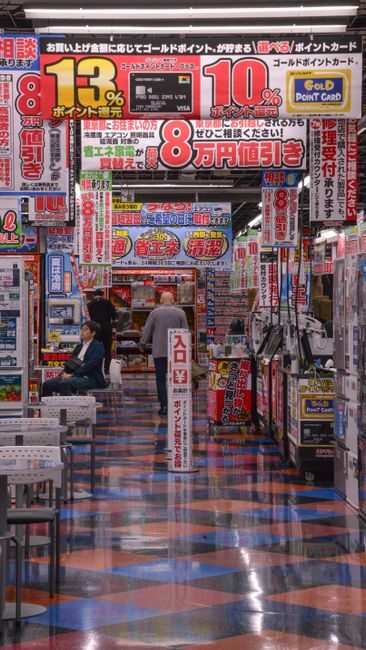
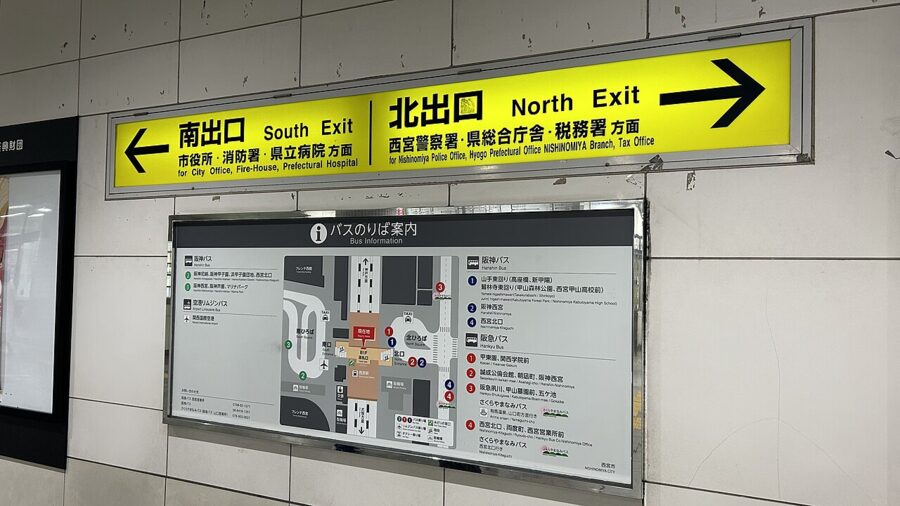
Two kanji do a lot of work here. 出 (out) and 入 (in) appear on every door, gate and parking lot, so 出口 and 入口 are worth learning with their kanji from day one. Then ask for help with えきはどこですか (eki wa doko desu ka, polite): “Where is the station?”
Weather
| Japanese | Romaji | English |
|---|---|---|
| てんき (天気) | tenki | weather |
| はれ (晴れ) | hare | sunny, clear |
| くもり (曇り) | kumori | cloudy |
| あめ (雨) | ame | rain |
| ゆき (雪) | yuki | snow |
| かぜ (風) | kaze | wind |
| たいふう (台風) | taifū | typhoon |
| かさ (傘) | kasa | umbrella |
| あつい (暑い) | atsui | hot (weather) |
| さむい (寒い) | samui | cold (weather) |
| あたたかい (暖かい) | atatakai | warm |
| すずしい (涼しい) | suzushii | cool |
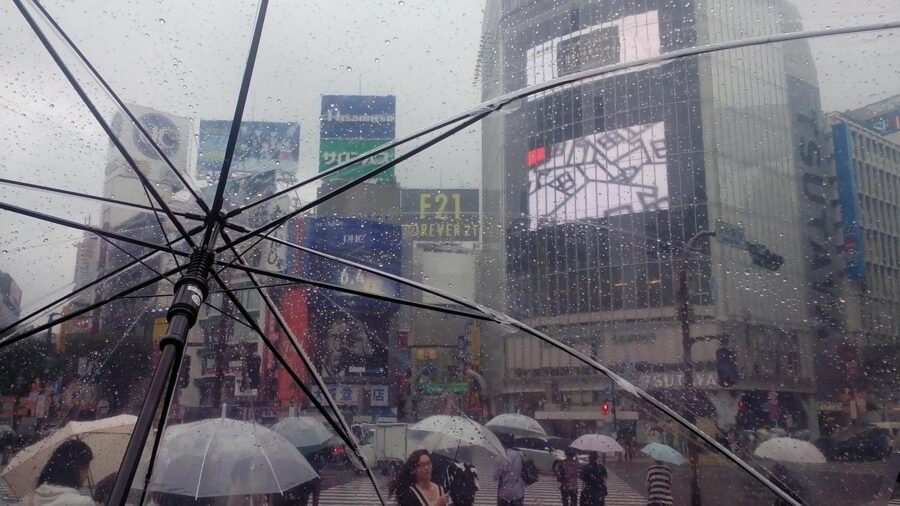
Weather is the small talk of Japan, and the four temperature words make a tidy set: hot, cold, and the two pleasant ones in between. Drill them together. In casual speech you’ll hear just さむいね (samui ne), “cold, isn’t it”, from shop staff and neighbors all winter.
One trap: かぜ with the kanji 風 is wind, but かぜ written 風邪 is a cold you catch. Same sound, different card.
Verbs you’ll use every day
Verbs get two forms on the card: the dictionary form you’ll look up, and the polite -masu form you’ll say to strangers.
| Dictionary form | Polite form | Romaji | English |
|---|---|---|---|
| たべる (食べる) | たべます | taberu / tabemasu | to eat |
| のむ (飲む) | のみます | nomu / nomimasu | to drink |
| いく (行く) | いきます | iku / ikimasu | to go |
| くる (来る) | きます | kuru / kimasu | to come |
| かえる (帰る) | かえります | kaeru / kaerimasu | to go home |
| みる (見る) | みます | miru / mimasu | to see, watch |
| きく (聞く) | ききます | kiku / kikimasu | to listen; to ask |
| はなす (話す) | はなします | hanasu / hanashimasu | to speak |
| よむ (読む) | よみます | yomu / yomimasu | to read |
| かく (書く) | かきます | kaku / kakimasu | to write |
| かう (買う) | かいます | kau / kaimasu | to buy |
| する | します | suru / shimasu | to do |
| わかる (分かる) | わかります | wakaru / wakarimasu | to understand |
Don’t try to learn the rule that turns one form into the other from flashcards. That’s Japanese grammar, and it sticks better from a lesson with examples. The cards just give you the two forms you need this month, so you can say わかりません (wakarimasen, polite), “I don’t understand”, without thinking.
Adjectives
| Japanese | Romaji | English |
|---|---|---|
| おおきい (大きい) | ōkii | big |
| ちいさい (小さい) | chiisai | small |
| たかい (高い) | takai | expensive; tall, high |
| やすい (安い) | yasui | cheap |
| あたらしい (新しい) | atarashii | new |
| ふるい (古い) | furui | old (things, never people) |
| おいしい | oishii | tasty |
| いい | ii | good |
| すき (好き) | suki | liked; to like (na-adjective) |
| きれい | kirei | pretty; clean (na-adjective) |
| げんき (元気) | genki | well, lively (na-adjective) |
Mark the na-adjectives on the card itself. きれい ends in い but behaves like すき, so it’s きれいなへや (kirei na heya), “a clean room”, not きれいへや. Learners trip on this for months unless the card warns them on day one.
Count them up and that’s a little over a hundred words. Don’t learn them all this week. The next part is about pace.
How spaced repetition works, in plain terms
In 1885 the German psychologist Hermann Ebbinghaus published what’s now called the forgetting curve. Memory drops fast at first, then levels off. Review a word just as it starts to fade and the next drop is slower, so the gap before the following review can be longer.
That’s the whole idea. You see a new word today, again tomorrow, then in three days, a week, a few weeks, a few months. Each successful recall pushes the next review further out, and each miss brings the word back to the start.
Software does the scheduling for you. Anki’s newer scheduler, FSRS, aims by default to show you each card when you still have about a 90 percent chance of remembering it, which keeps reviews few without letting words slip away. You press a button to say how well you knew the card, and it works out the date.
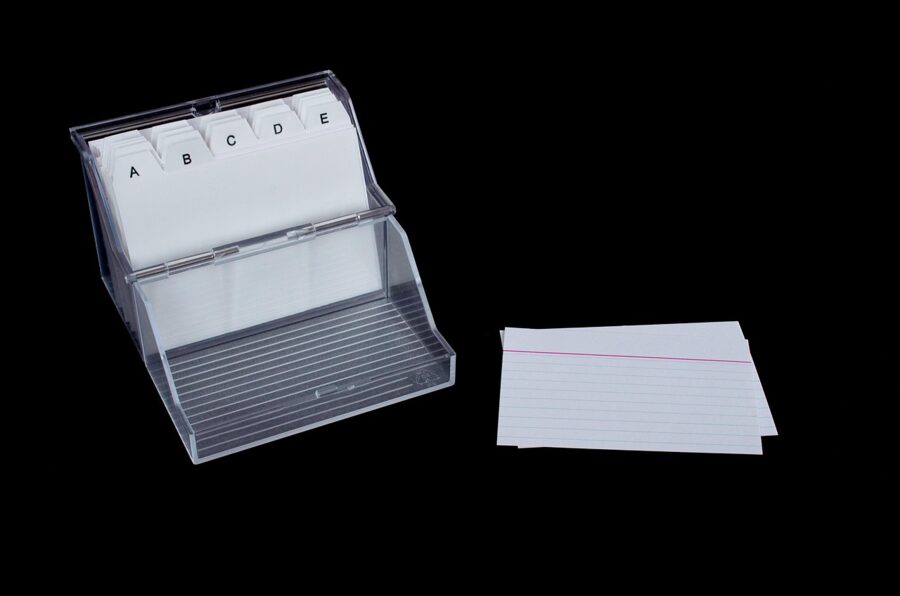
Paper can do the same job with boxes. The science journalist Sebastian Leitner’s system, from the 1970s, uses several compartments: right answers move a card one box along, wrong answers send it back to box one, and you check the later boxes less often. A shoebox with five dividers works fine.
How many new words a day?
Ten. That’s my answer for nearly every beginner, and I’d stick to it for the first month. Ten new cards a day is 70 a week and roughly 300 a month, which puts the usual 800-word N5 estimate within reach in about three months.
The number feels low because new cards aren’t the real cost. Reviews are. A common rule of thumb among Anki users is that daily reviews settle at around eight to ten times your new-card number, so ten new words become something like 80 to 100 reviews a day after a few weeks. At several seconds a card, that’s 15 to 20 minutes.
Push it to 30 new words and you’re looking at 250 or more reviews a day by the end of the month. Most people quit around there. If a week goes badly, cut new cards to zero and clear the reviews before you add more.
Paper cards or an app?
Both work. The best choice is the one you’ll open every day, and for most people that means whichever lives on the phone already in their hand.
Paper still has a real edge for the first few weeks. Writing a word by hand makes you notice every kana, and nothing beeps at you. Kokuyo’s Campus word cards (Tan-101B, 85 cards on a ring) list at ¥155 before tax, and Japanese students pair them with a red sheet: write the answer in orange or red pen and lay the red film over it to hide it.
Paper’s weak spot is sound. A card can’t say あめ aloud, and a Leitner box gets fiddly past a few hundred words. Most learners start on paper and move to an app within a couple of months.
| Tool | Cost (as of November 2026) | What it does well | Who it suits |
|---|---|---|---|
| Anki | Free on computers, Android (AnkiDroid) and the web; AnkiMobile for iPhone is $24.99, one time | Full control of the card layout, audio, the FSRS scheduler, huge shared deck library | Anyone who’ll spend an hour setting it up; the long-term choice |
| Quizlet | Free to start; Quizlet Plus is sold in the app at $9.99 or $44.99 in Apple’s App Store (United States) | Quick to make a set in a browser, games and matching modes | Class vocabulary lists and short-term cramming |
| Noji | Free with limits; Premium from $4.99 a month in the App Store | A friendlier interface, a library of ready-made decks | Learners who find Anki ugly and want something that just works |
| WaniKani | Levels 1–3 free; then $9 a month, $89 a year or $299 for life | About 2,000 kanji and 6,000 words in a fixed order, with mnemonics | Learners ready to tackle kanji, usually after the first month |
| renshuu | Free account | Spaced review tied to a dictionary, with ready lessons for textbooks like Genki and Minna no Nihongo | Textbook learners who want their chapter vocabulary drilled |
A warning about names. Noji used to be called Anki Pro, and despite the name it was never part of Anki. Anki’s own help pages say the real set is Anki, AnkiMobile, AnkiDroid and AnkiWeb, all linked from apps.ankiweb.net, so check the developer before you pay for anything called Anki.
Where should the words themselves come from? If you aren’t following a textbook, the Japan Foundation’s free course Irodori publishes word lists with MP3 audio for its Starter, Elementary 1 and Elementary 2 books. Those lists are built around daily life in Japan, so they overlap well with the groups above.
And the free option is enough. Anki on a computer plus AnkiDroid costs nothing, and paper costs a dollar. Pay only once you know you’ll keep going.
How to build a card that works
A good beginner card has kana on the front and the meaning on the back. Add sound and a short sentence and it gets much better. Here’s the layout I’d use for every card in the first month:
| Side | What goes on it | Example |
|---|---|---|
| Front | The word in kana, plus audio | あめ |
| Back | Meaning, kanji, a short example sentence with its reading and translation | rain (雨); あしたはあめです。 ashita wa ame desu. “It’ll rain tomorrow.” |
Why the audio? Because Japanese has pitch accent. In standard Tokyo speech, あめ meaning rain (雨) starts high and drops, while あめ meaning candy (飴) starts low and rises. はし is the same story: chopsticks (箸) and bridge (橋) differ only in where the pitch falls, which NHK’s pronunciation and accent dictionary marks for every entry.
You don’t need to master pitch now. You just need to hear the right version a hundred times. Anki can play a recording on the card, and for words you record yourself, a phone’s voice memo is fine.
Keep the example sentence short, and make it one you’d actually say. Three or four words beats a textbook line about Mr. Tanaka’s sister. If the sentence teaches a second word you already know, even better.
Run the cards in one direction first: Japanese on the front, English on the back. That’s recognition, and it comes fast. After two or three weeks, add reverse cards for the words you want to say, English on the front, and expect them to feel twice as hard.
When to add kanji
Put the kanji on the back from day one, next to the meaning, so you see 雨 every time you review あめ. Seeing it costs nothing. Testing it is a different job.
Once kana reads without effort, usually after three or four weeks of daily reviews, move the kanji to the front for words that are almost always written that way: 駅, 雨, 水, 出口, the day names. Leave words like おいしい and きれい in kana, since you’ll mostly see them in kana anyway.
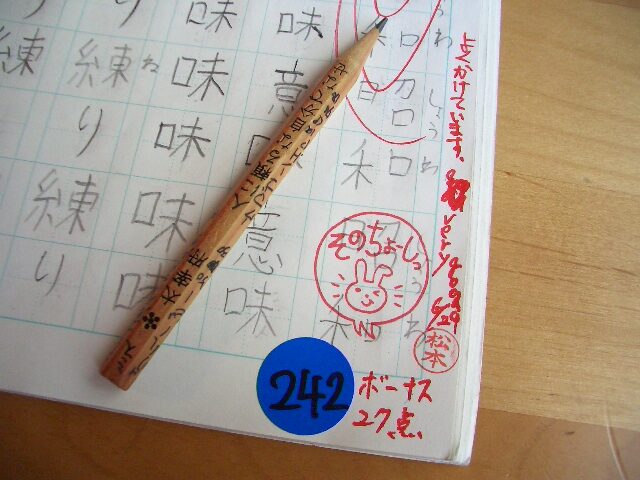

Kanji also let you cheat a little. 〜語 (-go) means a language, so にほんご (日本語) is Japanese and えいご (英語) is English. 〜人 (-jin) means a person from somewhere: にほんじん, アメリカじん. One card for the suffix teaches you dozens of words you’ll recognize on sight.
A first week you can start tonight
This plan assumes you read hiragana and have 20 minutes a day. Pick paper or Anki before day one, not during it.
- Day 1: Make ten cards from the food table, kana front, meaning and kanji back. Review them twice, once now and once before bed.
- Day 2: Review yesterday’s cards first. Then add ten time and calendar words, including the seven day names.
- Day 3: Reviews, then ten getting-around words. Say each one aloud with the audio, not in your head.
- Day 4: Reviews, then ten weather words. Write one sentence about today’s weather in kana: きょうはさむいです.
- Day 5: Reviews, then the first ten verbs in both forms. This is the heaviest day, so expect it to take longer.
- Day 6: Reviews only. No new cards. Go through any word you’ve missed twice and rewrite its example sentence.
- Day 7: Reviews, then ten colors and adjectives. Look around the room and name five things by color, out loud.
Sixty new words by Sunday, and every one of them heard, said and written. In week two, keep the same pace and add the body and animal groups.
The mistakes that slow beginners down
Romaji-only cards. They feel quicker, but you end up learning a spelling of Japanese that no sign, menu or app uses. Worse, romaji pushes English sounds onto the words. Kana on the front, always.

Too many new cards. The first week at 40 words a day feels great. The third week, with 300 reviews waiting every morning, is where people stop. Ten a day, and zero on a bad day.
No listening. A deck without audio teaches you to read words you can’t recognize when someone says them. Every card should make a sound, and you should say it back.
Downloading a giant deck on day one. Shared decks of 2,000 or 6,000 words sorted by frequency throw unrelated words together: umbrella, then parliament, then to regret. A deck you build yourself from words you’ve met sticks far better, and building it is half the learning.
Skipping days. Missing one day doubles the next day’s reviews; missing a week buries you. A five-minute session on a busy day keeps the schedule alive.
Cards with no context. A bare “あつい = hot” card won’t tell you whether it’s the weather or your tea. Add the sentence, and the card answers the question for you.
Back to that ring of 85 cards. Tonight, write ten words from the food table on them, kana large on the front, and read each one aloud twice before bed. Tomorrow, before anything new, see how many you still know.